Monday, November 07, 2022

Weekly Roundup #4

The days are shorter, colder and damper. I've now zipped the quilted liner into my raincoat and am wearing my somewhat itchy charity shop scarf. Soon I'll don my fleece gloves and hat. I'm slowing down. I'm still getting a lot of steps in and covering a fair amount of territory, but I'm no longer dashing from place to place in order to cram as much as possible into each day. Also, I'm trying to be better about doing a Pilates class (video replays from my home studio) a couple of mornings per week, and that means I'm out the door a bit later. And so, this week began at a more leisurely pace. Good thing, however, because I knocked it out of the park on Friday with a day trip to Cambridge (read on, mates).

I was again a bit at loose ends on Monday, as so many of the cultural institutions are closed that day or I've already been to the ones that are open or there's nothing on that particularly interests me at the other open venues. I decided to do another ramble from Stephen Millar's Hidden London Walks v. 4, this time Kentish Town. I've so appreciated that the publisher has provided downloadable maps of each of the walks, though you do need to read the books to get the intel about each of the spots. This particular walk takes in bits of Camden Town at the southern end, Kentish Town in the middle, and Gospel Oak at the north. I opted for the southern and middle bits. 


My ramble began by walking eastward along Prince of Wales Road until I reached the former
St Pancras Public Baths building (now the Kentish Town Sports Center as well as residential flats), which is Grade II listed. At the time it was constructed, there were four baths (pools) inside -- men's and women's, first and second class. The exterior clearly marks the first and second class men's entrances. Try as I might, I could not locate the doors that women used to access the baths. 


Next, I took a little detour to see a plaque to Boris the Cat in Anglers Lane.


I then nipped down Kelly Street, with its charming pastel houses, some decked out for Halloween.


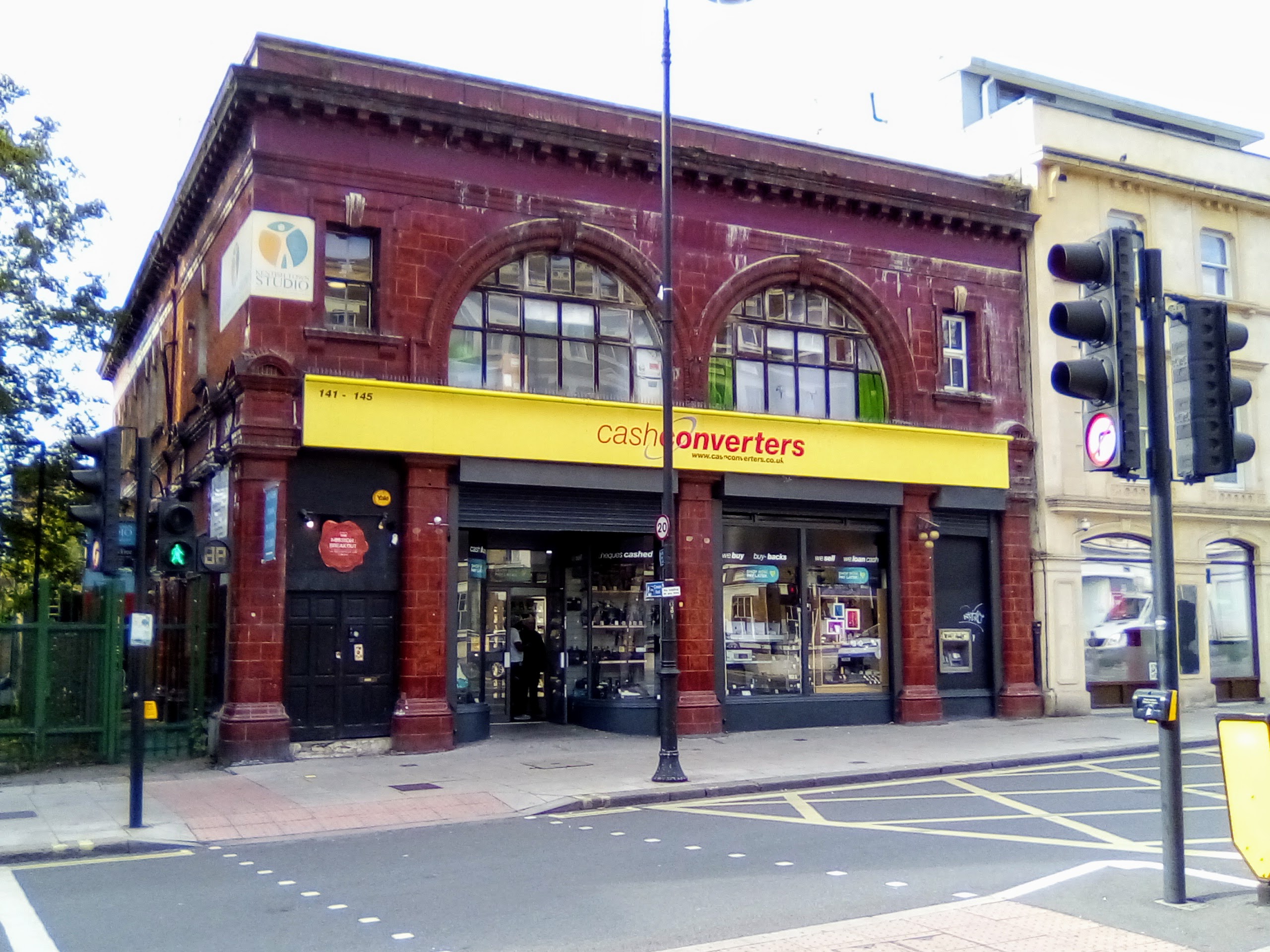
I headed south from there, in the direction of Camden Town along Kentish Town Road, stopping to look at what was the South Kentish Town tube station. Designed by Leslie Green in his signature oxblood red tiling, it was in use on what later became the Northern Line of the tube from 1907 to 1924. It's now a pawn broker. 

Across the road is a former public toilet, now Creation Studios. 


Reversing direction and continuing northward along Kentish Town Road, I came to the former storefront of Blustons ladieswear shop. I'd seen it from the number 134 bus three years ago and had wanted to get a better look. The family business operated for 84 years at this location before closing in 2015. (There was a brief attempt to reopen it under new management, but that only lasted two years.) Since 2018, the shop with its Grade II listed facade has been the home of a charity shop. The display windows are now full of vintage items. Unfortunately, the shop was closed for lunch when I came by, but I'll try to go back another day when they are open. Readers, do click on the three links to see some fantastic photos of the shop interior and exterior. 


I continued north as far as Kentish Town national rail station before bailing on the walk route, which would have taken me to Gospel Oak, and just ambled around instead. I bought a sandwich and went in search of some green space for a sit-down. This was not an easy quest. Kentish Town was booming in the 19th century as a residential area for working-class people -- primarily, I think, the families of Irish men who had come to London to work on the nearby canal and railroad -- and there aren't any squares, parks or even churchyards. I ended up doubling back to Talacre Gardens near Prince of Wales Road where I found a bench. After my late lunch, I zig-zagged my way back to Haverstock Hill and reached home just as the rain was starting. Along the way, I passed some interesting-looking businesses including Leverton & Sons funeral director that had been, according to its signage, owned and managed by the same family for eight generations and the Gipsy Queen, which looks like a great boozer.

In the evening, I hopped the tube to High Street Kensington to attend yet another free book launch at the Kensington and Chelsea Library. The book was Death Lines: Walking London's Horror History. The American author, Lauren Barnett, has a long-standing fascination with both horror films and London, living here now (I gather she married a Brit). She had looked for guided (or self-guided) walks featuring horror film locations and, having found none, wrote the book. I've never been that keen on horror films, but her book sounds so fun that I might just put a few in my Netflix queue for winter viewing. 

Tuesday started with a Pilates class and a bus ride down to Bloomsbury again. I didn't need to be anywhere until 2 pm, so I used the time to pop into some places I'd missed on my previous Bloomsbury junkets. I saw two gallery shows -- Stars at the Brunswick Art Gallery (mostly photos and prints of pop/rock stars) and masks by Romuald Hazoumè at the October Gallery. I wasn't so keen on the former, but enjoyed the latter and took a lot of rubbish snaps for a mate who loves masks. Here are two, but do click the gallery link above for much better photos. 


I then went back to the Wellcome Collection to see their new exhibition, In Plain Sight, which is all about vision and perception. It turned out to be a bigger exhibition than I'd expected, so I saw only about 3/4 of it but found it very interesting. Maybe that's because I've had rubbish vision almost my entire life and have had cataract surgery in both eyes. I grabbed a sandwich from the caff, shoved it down my gob and headed on.

I was due to meet my new friend Lesley at 2 pm in front of King's Cross Station. I seem to never learn how long it takes to get from one place to another along the Euston Road, so I was hustling all the way but made it only a few minutes late. Lesley is a walking tour guide who is currently doing the Camden guiding course. She needed to explore a few locations around King's X and Somers Town. I also wanted to check out a few places, and was happy to have good company. And Lesley was wanting to time some bits for one of her test walks and get feedback. After our ramble, we stopped for tea in the caff at the British Library. I'm really happy to have made a new acquaintance in London and look forward to staying in touch.

Wednesday took me to the National Gallery for the Winslow Homer exhibition and then to mooch around Lincoln's Inn and the Sir John Soane Museum. 

I LOVED the Homer exhibition. I'd originally thought it would be a bunch of seascapes that I'd already seen (the Clark Art Institute near home has a ton of his paintings), but was I ever wrong. I learned so much about him -- his work doing illustrations for Harper's Weekly during the Civil War, paintings in the south of African Americans during Reconstruction, and his lovely watercolours painted in Florida and the Caribbean. 


After gobbling down my packed lunch, along with a pastel de nata from Santa Nata in New Row (probably the best I've had -- warm, gooey custard and lovely flakey crust) while sat on a bench in the churchyard of St Paul's Covent Garden, I walked eastward across Covent Garden to Holborn. 


This was the first time I'd found myself near Lincoln's Inn when it wasn't the weekend (when the gates are closed to the public) so I took advantage and had a butcher's at the buildings, including the 
chapel and undercroft


I hadn't been inside
Sir John Soane's house since 2004. It's as bonkers as I remember, with artifacts, sculpture, architectural bits, paintings, etc. filling every nook and cranny. The house is just as it was when he lived there, so the objects have no labels or text to explain them. I could have used the Bloomberg Connects app to access more info about each room and its contents, but the app drives me nuts so I just wandered around. There's so much stuff to look at that you can't properly take any of it in, but as it's a free venue and utterly unique it really is a must-see. Maybe once is enough. 


Thursday was another grey, gloomy, damp day. I went to the City for a few hours and took in the London Mithraeum (a temple that dates to Roman times, under the Bloomberg building in Walbrook). Tickets are free but you must prebook as it's a popular venue and they don't allow many people in at a time. It's one of those immersive experiences that I sometimes balk at, but this is very, very well done. I learned more in a half hour there than I did in two hours touring the crowded Roman site in Bath. 

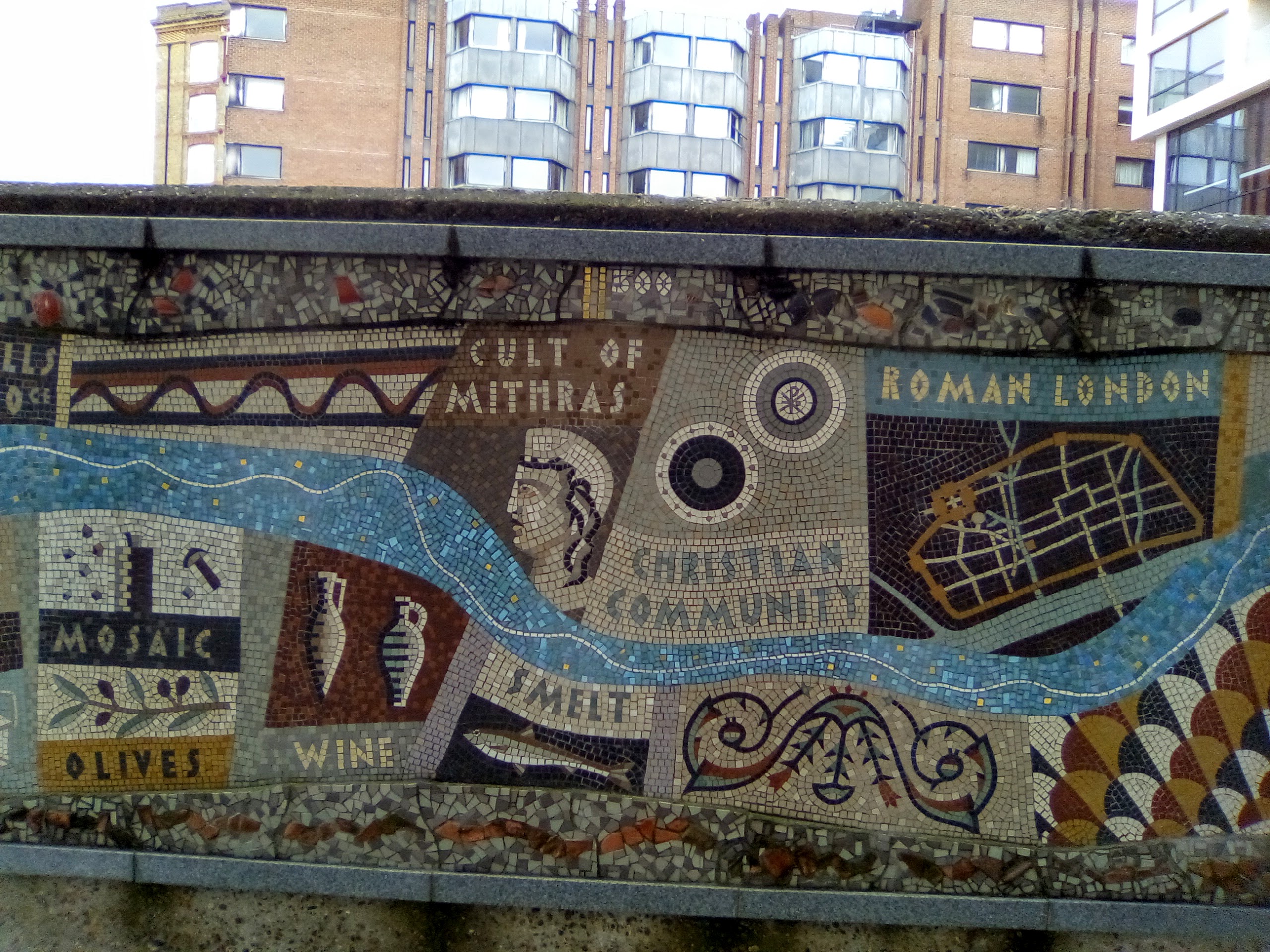
I dodged the raindrops and walked west along Upper Thames Street to look at the Queenhithe mosaic mural, which shows the history of the Queen's Wharf in tiled panels. It's lovely, but in need of a good cleaning.


Next, I popped into the
Bank of England Museum (also free) to see their exhibit on the Bank's connection to the slave trade. An interesting and informative installation, but far too many panels with a lot of text. I stumbled upon a room near the toilets that dealt with modern currency and included a short film about the polymer notes. At last I understood what this plastic money is all about and how they make it. (See my previous post about trekking up to Golders Green to exchange my now-worthless 20 pound paper notes). 

The Guildhall Art Gallery was my final stop in the City to see the exhibition Inspired. They've pulled a number of paintings and sculptures from their vast collection (owned by the City of London) and grouped them according to the artists' inspiration for the work -- poetry, music, literature and theatre. A lot of what the gallery has in it's permanent collection is Victorian allegorical paintings, so much of the exhibition featured these. Not my usual cup of tea, but there were also some more modern works that I liked. I also popped into their new (to me) undercroft gallery where they rotate a small number of works from the collection that depict London itself. I thought this was the best bit. 

In the evening, I met my friend Simon at King's X for a quick dinner and then over to King's Place to see Jerron "Blind Boy" Paxton, an African American blues, roots, ragtime, jazz performer. I love this music from the early 1900s and listen to it a lot on the radio but I'd never heard of Paxton. Here's his bio. An incredibly versatile and accomplished musician, he played guitar, fiddle, banjo, harmonica and piano during this performance. One his banjos, which has a lovely tone to it, was made in 1848 and belonged to his great-grandfather. In addition to the fantastic music, he entertained us with stories of his family, jokes and off-colour puns. He's in his early 30s, so here's hoping he has a long and celebrated career ahead of him. I'll be on the lookout for him passing through western Massachusetts. 

And that brings me to Friday, my day out of London to go to Cambridge. Greater Anglia was offering special 10 and 15 quid fares to select destinations if booked by midnight on 30 October. I've never been to Cambridge, and as it was on the list for a tenner, I booked for a day that looked like the weather would cooperate (it did) and the railway workers wouldn't strike (they didn't). Roger had sent me a link to the Defaced exhibition at the Fitzwilliam Museum (free with timed entry) about money, conflict and protest, so I booked for that as well. Other than that, I had no specific plan for the day other than rambling around, peering into the colleges (you can't actually enter them during term time), gawping at the architecture, seeing the punts on the River Cam, and possibly making it to Murray Edwards College to see their collection of works by women artists, allegedly the largest such collection in Europe. To recap: the Defaced exhibition was great, mooching around the colleges and lanes was lovely, and I'm SO glad I schlepped all the way up to Murray Edwards College (one of two women's colleges at Cambridge). Their art collection is displayed along various corridors of a multi-purpose brutalist building, interesting in it's own right. After all the medieval halls and gothic spires -- which I can relate to about as much as I can to Hogwarts -- it felt so nice to be where art occupies a space bustling with women, students and faculty going to and fro, rooms for study and dining, various offices and student services, and all that I know and love about a women's college. 

Here are some photos of the Fitzwilliam, the town streets and the university:


The Corpus Clock outside Corpus Christi College (sadly, I didn't see it strike the hour):


Murray Edwards College New Hall:


I was thrilled that the first art work I saw at Murray Edwards was by Faith Ringgold:


And so that's a wrap on this past week. It's been an odd week, a bit of a transition. I'm no longer feeling compelled to go, go, go, see, see, see. As a result, I have less of a sense of accomplishment at the end of each week. But on the other hand, I've been liberated from the tourist schedule and am feeling more and more like a Londoner. I've been very disconnected from what's going on with the mid-term elections at home, only hearing bits of news on the World Service. I'll need to pay more attention come Tuesday. To say I'm worried puts it mildly. 

One more full week and then a few days more before I head back home with very mixed emotions.

Stats: 

Monday, Oct 31
£3.25 sandwich from Pret
£4.79 groceries
22,387 steps
9.27 miles

Tuesday, Nov 1
99p Boots (throat lozenges)
£4.25 sandwich
£10 hummus and wine
21,293 steps
8.85 miles

Wednesday, Nov 2
£6 Homer exhibition (half price with Art Pass)
£2.10 pastel de nata
£3 groceries
15,945 steps
6.56 miles

Thursday, Nov 3
£3 Guildhall Art Gallery (half price with Art Pass)
£2.15 groceries
£4.50 dinner at Leon 
£24.75 performance at King's Place 
20,278 steps
8.32 miles

Friday, Nov 4
£10 train ticket to Cambridge
£1.80 pastel de nata
£13 groceries and wine
27,484 steps
11.47 miles

Tuesday, November 01, 2022

Fourth Weekend: Walks and Art


I can't believe that I just typed the title of this post, but yes, indeed, it is my fourth weekend here in Blighty. I've really settled into a routine and am feeling more and more like a local. I'm more confident and am consulting Google maps far less as I'm out and about, which sometimes leads to interesting or amusing consequences. 

Saturday morning started as usual with a walk up to the Parliament Hill Farmers' Market. No need for the map to get me there -- just head up Lawn Road past the streamlined, modernist Isokon flats and keep going northward. I can now easily find the foot bridge that takes me over the railway tracks to Parliament Hill Fields. Even before the bridge comes into view, I know I'm in the right place from the distinct odor of urine -- a pungent mix of human and animal -- that precedes it. (The smell dissipates once you reach the other side of the footbridge and the football pitches on Parliament Hill Fields.) At the market, I bought my veg, bread and a samosa, and then walked over to Highgate Road to catch the C11 bus back to England's Lane. But something looked amiss. Roadworks were taking place, and though cars and buses were coming UP the hill, none were going DOWN. I'd neglected to consult the Citymapper app and didn't realize that the C11 would be on diversion around the roadworks. And so I walked, laden with my purchases, past Gospel Oak station and finally met up with the C11 in Mansfield Road. 


Seeing the Isokon earlier was a nice set-up for my afternoon activity -- a walking tour with my friend Jane, featuring art deco architecture around Piccadilly. The meeting point was the ticket concourse in Piccadilly Station, a place I'm sorry to admit I've never been, next to the tribute to Frank Pick, the man who brought modern design to the underground. We were met by friends Malcolm and David (the other punter scheduled to be on the walk was a no-show)


Jane explained the various art deco features of the station, and things to look for in art deco buildings in general, before leading our jolly little band out onto the busy streets, full of shoppers and people getting an early start on their Halloween revelry. We looked at exterior and interior details of some fantastic buildings -- the former Simpsons menswear store (now Waterstones in Piccadilly) with it's concave display windows, the former Austin Reed clothing store (now Uniqlo in Regent Street) that still has the fixtures of their art deco barber shop on the lower floor, as well as exteriors of several cinemas and theatres, etc. Because it was just us four mates, Jane was able to weave in places and stories she usually doesn't get to include when the tour keeps to a strict time table. The most fascinating tale was about the Electrophone company, based in Gerrard Street, and its subscription live audio system that began in the early 1920s. Think of it as a precursor to the BBC, National Theatre Live and Netflix -- you paid an annual subscription fee and called an operator to request to be connected live performances from various entertainment venues. Then, you and your friends would sit around wearing headphones with handles to enjoy the performance. Totally wild! I had so much fun on this walk, with looking at the buildings and chatting with my friends, that I forgot to take any other photos using the crap phone camera (that's what I use for this blog), so you'll just need to wait until I upload to ipernity the ones I took with my proper camera.

Once the official part of the tour ended and we all felt the need to escape the environs of Leicester Square, we headed to the Salisbury, a grand Victorian boozer, for a meetup of the old lags of the Guess Where London group on Flickr. We all met through the group and have known each other for 10 or 15 years. Covid and travel restrictions kept us apart the last three years, so this meetup was long overdue. It made me so happy to see these folks. They inspire me to continue to explore London and to keep up my photography, they embrace me when I visit London, and they keep me connected to Blighty when I'm back home. 

Each week, I've been trying for a low-key Sunday, with mixed success. This weekend I did a bit more than last, but didn't push myself too much. In the morning, I went on a guided walk about Modernist Hampstead -- an uphill tromp to the meeting point on Heath Street, then a two-hour tour around the area, seeing a variety of residential buildings dating from 1930-1950-ish, ending at the Isokon. Our guide Marilyn told us at the outset about the quintessential architectural elements of this period that we should be on the lookout for: form following function, flat facades, exterior concrete supports, minimal ornamentation but for stylized motifs, metal window frames and flat roofs (and maybe a few others that I don't recall). We stopped to look at many buildings I'd walked right past in my previous rambles, but I hadn't taken notice. We also stopped to look at some I knew well, like 2 Willow Road and 66 Frognal (my favourite). The official walk ended at the Isokon flats, where we were then encouraged to look at the gallery with lots of furniture and artifacts from the building's history. The gallery, open limited times and only in the nice months, is staffed by volunteers who are themselves residents of the building. One resident who was on duty in the gallery offered to show us his flat. He has collected furnishings and decorative items that were original to the Isokon and/or classic examples of the Isokon design aesthetic. We got a glimpse into a tiny, cosy art deco bedsit like nothing I've ever seen. So cool!


After a quick lunch back at my gaff, I got the tube for Waterloo to see Strange Clay at the Hayward Gallery. The Hayward has been closed a lot recently (covid, renovations), so this was the first time I'd seen an exhibition there in several years. I always like their exhibitions as they tend to be edgy, challenging your notions of art, and often downright fun. This one was all of that and I thoroughly enjoyed it. 


I nearly forgot -- on Saturday, one other thing I did was to pop into Hauser & Wirth on my way to the walking tour. I saw the exhibition of paintings by Amy Sherald, the artist who did the portrait of Michelle Obama that hangs in the National Portrait Gallery in Washington, D.C. 

The sunny and warm days of October have now ended. We set the clocks back here on Saturday night, so sunset now comes shockingly early. The days have become rainier and colder. And thus we begin the slide into winter.

I've got two weeks left here, with as yet only a few activities slotted in. Watch this space for further developments. 

Stats:

Saturday, Oct 29
£12.90 farmers' market purchases
£10 Piccadilly deco walk
20,939 steps
8.83 miles

Sunday, Oct 30
£10 Hampstead Modernism walk
£2 Isokon donation
£7.50 Hayward Gallery (half price with Art Pass)
£1.50 veg
20,291 steps
8.28 miles

Monday, October 31, 2022

Weekly Roundup #3


This past week was half term, with kiddies out of school and their exasperated parents trying to find activities in which to engage them. As the parks and big museums are free, these are a prime destination for families, with many venues planning special activities for the hoards of children pouring through the doors. Smaller museums are also popular family destinations, though to a lesser extent. And so, I decided to stay away from all of them. There's nothing that spoils a museum experience faster than a bunch of pushchairs, whinging children and general misbehaviour. Oh, and coughing. If your kid has a cough, please, please keep the wretched thing at home!

I hit the pavements again, starting on Monday with a long walk through the village of Primrose Hill, a bit into Camden Town, and back in a big circle around Primrose Hill itself. It was a gorgeous autumn day and I had a grand time. Primarily following a route laid out in Stephen Millar's London's Hidden Walks v.4, I roamed past upmarket shops in Regent's Park Road and along the length of pretty Gloucester Avenue. Heading further south, I did a loop on Parkway, Albert Street (with a stop at Ferriera's Deli, where the pastel de nata are only £1.50), Arlington Street with the enormous Arlington House (a Victorian doss house now used as council-supported transitional housing), over the canal at Camden Lock and back along the towpath to Gloucester Avenue again. From there, I resumed Millar's walk and looked at a former piano factory (now flats), blue plaques for W. B. Yeats and Sylvia Plath, and charming pastel houses, including the ones used for exterior shots in the Paddington Bear films. Back in the park, I walked past Shakespeare's Tree, then to the western and northern edges of the park before exiting and walking home. 


Whenever I visit London, I always try to explore one or two areas that are entirely new to me.
Tuesday was my day to do just that with a mooch around Hackney Wick, Fish Island and bits of Bow. I had made myself a Google map from my pre-trip research, plotting out a route that would take me past some of the more notable streetart in the area, into a corner of Victoria Park and picking up the eastern end of Stephen Millar's walk of Mile End and Bow, which I'd started in 2017 but never finished, before ending at Fish Island (not really an island) and back to Hackney Wick overground station where the walk began. Weather varied throughout the day -- mostly overcast, occasional drizzle and glimpses of sunshine. 

I got the Overground from Hampstead Heath to Hackney Wick and had a butcher's around the nearby streetart (Noir's guitar players and the Lord Napier Pub) before crossing to the eastern side of the River Lee Navigation and then walking down the towpath for a while. This area is adjacent to the 2012 Olympic venues, now a park. I then crossed back to the western side of the Lee Navigation and headed down the towpath of the Hertford Union Canal and past several locks. These are the waterways evocatively depicted in Michael Ondaatje's Warlight, an amazing book that I read during lockdown. I nipped into Victoria Park to see the Burdett Coutts Memorial Drinking Fountain (restored just prior to the Olympics) and to eat my packed lunch, then crossed the canal again to go south into Bow. 


Zig-zagging my way towards Mile End Road, I saw a suffragists mural on the side of a pub, Georgian terraces, the lovely Tredegar Square (often used for filming movie exteriors), and the usual mashup of Victorian, Edwardian and new-build. Everywhere I went, I saw the ubiquitous purple Poplar wheelie bins. Along the way, I paid my respects to the Lansburies (a plaque to George and a clock dedicated to Minnie), and saw the recently unveiled blue plaque to the women and girls who struck the Bryant and May matchbook company in their struggle for better wages and working conditions. 


It was 4 o'clock by the time I reached my ultimate destination -- Fish Island. Not exactly a proper island, this Victorian industrial enclave is bordered by the Lee Navigation, Hertford Union Canal and the A12 motorway/Blackwall Tunnell Approach. As various creative people and streetartists have moved ever eastward, driven out of areas like Shoreditch and Dalston by gentrification and increasing rents, Fish Island seems to be a place they are moving to, even as construction sites abound and probably luxury flat conversions of old factory buildings. But it's still possible to catch sight of the vestiges
 of London's industrial past, including a peanut factory and the eyeglass frame factory where John Lennon's famous spectacles were made. From there, I crossed the canal again and walked the short route northward back to Hackney Wick station.


Whew! That brings me to Wednesday, a rather quieter day in comparison. I started by dropping in for some delicious coffee cake at the Primrose Hill Community Association. I've been joining in on some of their weekly walks and I wanted to check out their facility and re-opened (since covid) cafe. The facility is a fantastic asset for the Primrose Hill community, located in what was the boiler house of the former piano factory I'd seen on Monday. I'm not sure if the target clientele of the cafe are the less well-off residents of the area, in need of support and social contact, or anyone from this economically mixed village. Seems there is a broad umbrella. I chatted with a woman who is living in supported accommodation and facing the end of her time there, and with a volunteer, a former teacher, who gave me theatre reviews and recommendations.  


I then hopped on the tube to Old Street to make my way along the City Road to the Victoria Miro Gallery at City Road Basin. ("Up and down the City Road, in and out of the Eagle. That's the way the money goes. Pop goes the weasel.") If I've ever walked along this part of the City Road, it must have been a long time ago before it was so built up or else I've forgotten how awful it is. There are new, high buildings every (probably more luxury flats). The wind was blasting down between them to the pavement below, and the congestion and noise were horrific. Remarkably, the Euston Road, which I'd long held as the worst road in London, is more pleasant. The gallery, in an old warehouse, is capacious and quiet, however. I saw two exhibitions: Alice Neel and Secundino Hernández.


With time to kill until I was due in Islington for a tour of Canonbury Tower, I got a meal deal sandwich and meandered around, stopping in at Shepherdess Walk Park to eat my lunch and admire the mosaics. It was a lovely day for a leisurely stroll through a part of Islington I'd never seen. Canonbury Tower, built in the early 1500s (that makes it Tudor), is now owned by the Marquess of Northampton. Over the centuries, some famous names lived or visited here, including Frances Bacon, Thomas Cromwell and Oliver Goldsmith. The Marquess now permits the Islington Guiding Association to do a occasional tours for a limited number of people. My friend Jen was on the rota to lead the tour this week and invited me to come along. What a cracking tour it was! It's a unique and rather bonkers building, with lovely oak paneled walls (one with bullet holes in it -- allegedly), graffiti dated 1736, and a marvelous view across London from the flat rooftop 66 feet (20 meters) above the ground. Jen told us fascinating tales of people connected to the tower, and relayed the story of her first association with it, back before she ever thought of becoming a guide, when she won a treasure hunt that ended in the tower. I'm not going to give away the details, so you'll just need to book a tour for yourself. In the meantime, here is an article about the tower featuring one of the other guides. Sorry, but the Marquess does not allow photography inside the building.


On
Thursday I finally got to visit Dungeness! This isolated spot on the Kent coast has long been on my list of places to see. It's part wildlife reserve, part working fishing community and part holiday cottages. My friends David and Janie had never been there either, and so we planned a day trip. It's difficult to get there by public trans, and I was grateful to have them offer to drive.

We ate fish lunches at the Snack Shack,


walked on the shingle beach to look at wrecked wooden boats,


and had a wonderful tour of Prospect Cottage, former home of the artist, film maker and gay rights activist Derek Jarman. For many years, even after Jarman's death in 1994, people could visit his rock gardens, lovingly planted over the years he lived in the cottage, using plantings that could survive in the harsh coastal climate. Since the death of Jarman's partner Keith Collins in 2018, the house has been maintained by Creative Folkestone and they have recently opened the cottage to visitors. Tours are limited in frequency and number of people (4 at a time). The gardens are lovely and show Jarman's creative hand, but it's inside the cottage that you really get a feeling for who he was and what was important to him. The cottage is essentially as it was when Jarman and Collins lived there, with furnishings and collections still in their original places. On the walls hang Jarman's paintings, many of which depict his emotional state as he lived and ultimately died of AIDS. Collins left meticulous documentation of the contents and the guides have soaked up that information. Whenever one of us on the tour pointed at an object and asked about it, one of the guides could give us full details. It's clear that the guides love working there and sharing this place with visitors. Again, no photography allowed inside, but we were allowed to spend as much time as we wanted taking photos around the exterior.


On Friday morning, I needed to do errands. First call of duty was to complete my absentee ballot and put it in the post back to Massachusetts. The local post office in Belsize Park, located inside Budgen's supermarket, is closed while the store is undergoing renovations. My next nearest options were Primrose Hill or Swiss Cottage. I opted for the latter in order to combine it with grocery shopping at Waitrose in the Finchley Road. After my great experience the week previous at the post office in Golders Green, I just assumed that any post office would give me efficient and courteous service. Was I ever wrong! When I arrived, I was sixth in the queue and soon there were at least another half dozen people behind me. It took a half hour for it to be my turn. The two women at the counter were working at a snail's pace and didn't give a rat's arse about being cordial to customers. Parcels were strewn all over and there was litter on the floor and counters. When looking up the location on Google, I'd noticed that the reviews gave this post office 2.8 stars. That is truly generous. 

After lunch back at my gaff, I looked over my spreadsheet for a small museum that would probably not attract too many annoying children. I decided to head down to Holland Park to visit Leighton House (free with my Art Pass), which has recently reopened after covid and a major refurb to the reception, cafe, gift shop and toilet areas (now all in the building next door that had formerly been their admin offices). No kids inside, but lots of people, mostly elderly posh types. The rooms -- more of them than I'd remembered viewing before -- are a treat to see, especially the Arab Hall with its blue and gold mosaic tiling and soothing fountain bubbling up from the middle of the floor. When I was last here, it was to go to a souk that was taking place in the studio, making it hard to get a good sense of that room. Now I could enter it as one of artist Frederic Leighton's visitors, models or clients would, with light pouring in and beautiful objects on the rose-coloured walls. After wandering around all the rooms, I exited through the cafe into the large back garden to sit and enjoy the greenery, only to be met by two children running around and screaming at the top of their lungs. I left, a bit peeved but glad I'd made it to 4 pm on Friday without encountering annoying urchins and their oblivious parents.


Stats:

Monday, Oct 24
£1.50 pastel de nata
£1.49 bread
19,295 steps
7.91 miles

Tuesday, Oct 25
£2.50 carrot cake
£10 to top up my Oyster card
25,854 steps
10.6 miles

Wednesday, Oct 26
£2 cake
£2 sandwich
£18 Canonbury Tower tour
£2.50 Ginger Nuts & apples
£9.50 shirt from M&S
22,666 steps
9.3 miles

Thursday, Oct 27
£7 Prospect Cottage tour (half price with Art Pass)
£6.40 beverages 
£ some amount to travel to/from Zone 4
14,897 steps
6.16 miles

Friday, Oct 28
£4.20 postage to mail ballot to US
£10.75 groceries
£8 wine
16,127 steps
6.59 miles