Tuesday, October 17, 2023

Fourth Week: Living Like a Londoner

It's been a week of doing small things -- the sort of things that generally wouldn't be prioritized by a tourist in London for a short visit -- and of catching up with friends. I'm in a real routine now, planning ahead a day or two at a time (but for things I need to pre-book), depending on the weather, my mood and interests. There's been time for doing the shopping and laundry, as well as walks here and there. It's sometimes hard to remember my old routine back in Massachusetts as I've totally taken to life here, but I know I'll soon start missing home and be ready to head back.

Before I tell you about my Week Four activities, I thought I'd answer some questions I'd received about the gear I'm using on this trip. My most significant piece of new gear is a Peak Design Everyday Sling 3L, which I'm carrying instead of the Eagle Creek cross body field bag I'd been using for years. When I travel, I've always had trouble with lower back pain, particularly when doing a lot of stop-and-start walking and leaning in to read something. Museum and gallery visits really aggravated this. My thinking (and my chiropractor agreed) is that, given my scoliosis and lower back issues, it would be better for me to carry a bag that located the weight more over my core than on one hip like the field bag did. So a sling bag, though not the most stylish thing in the world, seemed a better option. I was wary of this bag at first as it's smaller than my field bag and has less internal organization, but I'm coming to love it and my back is thanking me for it. The small size is forcing me to be more judicious about what I tote around with me every day, but I can get the essentials into this sling. It's extremely well padded and utterly waterproof (including the amazing zippers), and has a customizable internal divider. My camera fits perfectly inside and I don't have to put it in a case, so I can pull it out very easily. 

In addition, I bought a Bellroy City Pouch for carrying the bare minimum of things I need when I go out at night or run down to the shops -- phone, keys, Oyster card, wallet. Again, it's made with waterproof material and zippers, which is a necessity in such a rainy climate. Whichever bag I carry, I always pop my Nanobag inside. It's a fantastic ultra light, extremely strong, sustainable and reusable shopping bag with 19L capacity. Nanobags come in a variety of patterns and colours -- mine is a cheery floral print that looks fab with my coat. Lastly, I always attach a HeroClip Mini to my bag -- it weighs next to nothing and comes in handy for attaching things, hanging my bag from a toilet stall door if there's no hook, or securing my bag to a chair in a restaurant. 

Now to the week's activities:

In the arts and culture category, the following:

  • Mondays are a bit tricky to plan for, as many galleries and museums are closed, but the V&A is always open and so I spent several hours there. First, I saw the Prix Pictet 2023 finalists exhibition. This is an annual prize for photography and sustainability, and this year's theme is Human. Each of the dozen semifinalists from around the world had 8-10 absolutely stunning photos on display showing their unique take on the theme. I then wandered around in the Medieval & Renaissance Galleries (European art and culture from 300-1600). I don't know much about those centuries, but I enjoy and marvel at the skilled artisanship that went into crafting the beautiful objects. And the MedRen Galleries are usually quiet, not crowded, and nearly child-free. Lastly, I looked at the displays in the recently reopened Photography Centre, where I saw Energy: Sparks from the Collection and Between Two Worlds: Vanley Burke and Francis Williams. Oh, and I took a quick spin through the Cast Courts and stumbled upon the Leighton Frescoes while trying to find the loo.

  • Not wanting to spend any more time indoors, missing out on what was a drop-dead gorgeous autumn day, I headed up to Kensington Gardens to see this year's Serpentine Pavilion where, as is my annual custom, I ate my packed lunch. This pavilion is designed by a woman and is much more airy and light than last year's black hole, though it does look a bit like it was constructed from Ikea flat packs. After my late lunch, I took a leisurely stroll along the Serpentine Lido and Rotten Row, finishing up with an overpriced gelato before getting back on the tube at South Kensington.


  • Tate Modern for El Anatsui's installation in the Turbine Hall (huge! amazing!) made of flattened metal liquor bottle caps and the exhibition A World in Common: Contemporary African Photography. The photography exhibition is organized around the themes of identity and tradition, counter histories, and imagined futures. Within each category are a range of subjects and techniques -- the pieces being large, colourful and like nothing I'd ever seen in a gallery or museum before. By a very happy coincidence, my friend Kathy was at Tate Modern that same afternoon to see a different exhibition, so we seized the opportunity and spent a lovely hour catching up over tea on the terrace. 


  • Another look at (smaller) pieces by El Anatsui at the October Gallery in Bloomsbury. As much as I was awestruck by his gigantic pieces in the Turbine Hall, I found these smaller pieces much more intimate and accessible. Both are well worth seeing. 

  • Espacio Gallery in Bethnal Green to attend the opening reception for my friend Jen's photo exhibition. She's a member of the Royal Photographic Society and this was the London Regional Projects Exhibition, a group show of about 50 or so members, each displaying one panel. Photos were organized around three themes: the Magnificent 7 + 1 cemeteries, independent traders and the coronation. Jen had a panel of great photos of graves in Highgate Cemetery. I thoroughly enjoyed looking at the panels and meeting several of Jen's photographer friends. I came away inspired and with a couple of ideas to pass along to my photo group at home. 
  • Lisson Gallery's exhibition by Ryan Gander called PUNTO! Very different to anything else I'd seen thus far. Watch the short video in the link. 


  • Centre for British Photography, a new gallery in Jermyn Street that opened in January of this year, had five different exhibitions going all at the same time. I went with my friends Jane and Malcolm, and all of us found things to enjoy in the photography. My personal favourite (and perhaps that of my mates as well) was Daniel Meadows: Free Photographic Omnibus, 50th Anniversary, a retrospective celebration of the photos Meadows had taken when he traveled around England in a bus that he had converted to his home and darkroom. The other exhibitions were Charlie Phillips: How Great Thou Art, 50 Years of African Caribbean Funerals in London, Dorothy Bohm: London Street Markets (photos taken in the 60s and 70s), Grace Lau: Portraits in a Chinese Studio (she has recreated a photography studio with a bunch of "fake props" -- her term; we talked to her -- and people book to have her take their photos, a selection of which she has displayed on the walls in what was my second favourite exhibition), and Arpita Shah: Modern Muse. The space occupied by the gallery (half of what was/is the Dunhill shop, a fab 50s modernist building) is far roomier than what the Photographers' Gallery has, making for a much more pleasant viewing experience. I'll definitely be going back in future years. 
  • Auction preview at Christie's. After seeing the above photo exhibitions, we popped into Christie's to have a butcher's at what was coming up for sale, which was Modern British and Irish Art. They had some lovely pieces, several of which we each thought would look dandy in our homes. A live auction was going on at the time in an adjoining room and it was fun to peek in at that.
A couple of things in the history department:
  • Revisited the Charles Dickens House to learn all about the fog that used to plague London. I love this little museum, and it's free with my Art Pass so always worth popping in.
  • Went to a talk about women incarcerated in Holloway Prison, held at the Primrose Hill Community Association as part of their Wednesday Open House series.
  • A guided walk about the navvies (the navigator engineers who did the grueling manual labour to dug the canals and lay the railroads) in Primrose Hill and Camden Town, arranged through the Primrose Hill Community Association.
Two day trips out of London:
  • Bexhill-on-Sea and St Leonards-on-Sea. My friends David and Janie, who have generously treated me to some fine days out of London, took me down to the East Sussex seaside on what turned out to be a grey and blustery day. We first visited the De La Warr Pavilion in Bexhill, an art deco building on the seafront that houses exhibition and performance spaces, a gift shop and a vinyl record stall (who knew there was such a thing?), and a restaurant. We looked at the art installations, had a yummy fish and chips lunch in the restaurant, and were buffeted by the wind as we walked along the shingle beach, with David and me both trying to get some photo ops. Back in the car, we drove a wee bit east to St Leonards, arriving to less wind and more pleasant conditions for a wander along the beach and through the streets of the town. Bexhill seems a bit tired, while St Leonards feels like a more vibrant, arty/funky place, perhaps one for a return visit.


  • Canterbury -- I seized the opportunity for a sunny day without rain (though very cold!) to take the train to Canterbury so I could tick off another cathedral city. When I first arrived on the train, as it was too early for the 12:30 pm Sunday opening of the cathedral, I walked along some of the old city wall, with its battlements and a very high mound, and through Dane John Gardens. Mooching my way toward the city centre, feeling a bit peckish after my train journey and lured by the display of baked goods in the window, I stopped at the Tiny Tim Tearoom and bought what has to be the best scone I've ever had in my life. Called a "Plump Pilgrim," it's full of citrus bits and topped with a big dried cherry. At the cathedral, I shelled out the 17 quid entry fee and made sure that I saw every bit of it that I could, including the spot where Thomas Becket was murdered and his memorial. I spent a lot of time looking around in the crypt, which has a chapel with medieval paintings on the walls and columns with all kinds of creatures carved on the capitals. At the spot in the crypt where they believe Thomas Becket was killed hangs a sculpture by Antony Gormley, the outline of a body made entirely of nails pulled out during a renovation of the cathedral. I had seen some signs saying that there was no photography allowed in the crypt -- owing, I think, to the fact that it's a spot of ongoing prayer -- but none in the section with the nail sculpture. I had just pulled out my camera and taken a snap of it when a teller-offer appeared at my shoulder to remind me that photography was not allowed. So, no phone photo of it for the blog. Sorry. Other than the cathedral, there's really not much to do in Canterbury. The streets were rammed with people, I reckon a mixture of tourists and locals, and there was a food and crafts market in one of the pedestrianized streets. I looked for someplace that would show me the history of the pilgrims and pilgrimages to Canterbury, but didn't find anywhere. What I did see were a lot of Ye Olde Half-Timbered Cottage Lane Shoppe kind of places -- charming at first, but too much after a while. Five hours was more than enough for my visit. 


And finally, more theatre, this week the play Octopolis (again at the nearby Hampstead Theatre) starring Jemma Redgrave. This performance is in the wee black box space downstairs, holding probably about 80 people. It's a two-hander and full of emotional stuff, interpersonal relations and conflict, grief, etc. -- it often flew at me too quickly to process, but the performances were commendable with the dense -- and sometimes funny -- material. 


After so many warm and sunny days, it's suddenly turned cold. Last year, I stayed into mid-November and it wasn't as cold as it is here now. A week or so ago, I had stopped into the Mind charity shop in Haverstock Hill again, just to see if they had any warm jumpers in case I might need one, and saw an olive green, light weight puffer jacket for 12 quid that I thought might fit the bill if we had a cold snap. When I woke up Saturday morning and found that the temps had plummeted, I got a wiggle on and went back to the shop. The puffer jacket was still there and now it's mine. The weather this coming week will be back to seasonal temps, but there's rain coming. And so it goes on this damp island.

Stats:

Monday:
£4.75 gelato
£2.80 loaf of bread
19,332 steps
7.87 miles

Tuesday:
£3.80 sandwich
£8 bottle of wine
£8 Tate Modern exhibition
21,013 steps
8.58 miles

Wednesday:
£2.05 Forgotten Ends sushi cup
£1.80 pastel de nata
£12.80 groceries
19,906 steps
8.13 miles

Thursday:
£15 Hampstead Theatre ticket (OAP matinee price)
£11 groceries
15,630 steps
6.39 miles

Friday:
(No expenses -- I was treated to the daytrip to East Sussex!)
17,221 steps
7.1 miles

Saturday:
£ 4.80 farmers' market
£12 puffer jacket at charity shop
£6.75 pint of Guinness
£8.85 ginger nuts and bottle of wine
85p more throat lozenges 
19,301 steps
7.97 miles

Sunday:
£29 return train ticket for Canterbury
£17 Cathedral ticket
£2.45 scone
£3 glass of wine
22,926 steps
9.34 miles

Monday, October 09, 2023

Third Week: Things slow down wee a bit

My adventures have been less frenetic this week, owing to several factors. Just before I arrived, I learned that there were to be tube strikes on 4 and 6 October as well as a rail strike on 4 October. I quickly changed my rail ticket to Eastbourne originally for 4 October to 19 October. And, after being caught in the tube strike last year when it took me nearly three hours to get home from Blackfriars, I cleared everything from my calendar for the 4th and 6th, figuring I'd stick to NW1 and NW3 on those days. In addition, many of the galleries were changing over exhibitions this past week so there was less to see. And finally, my sinuses/allergies have been acting up something fierce or, if it's worse than that, I've got a cold or a sinus infection. But it is NOT covid -- I've done two tests, 48 hours apart, both decidedly negative. My head has felt like a pumpkin the past few days, so I haven't taken on any far-flung adventures. I'm starting to feel a bit better, however, and I'll be off to uncharted areas in the coming two weeks.

In my last post I wrote about how I plan and organize my time. In this one, I thought I'd write a bit about food -- where I procure it, what I eat and how I prepare it. I've never been big on eating out in London as it's so bloody expensive. Food purchased at green grocers, supermarkets and farmers' markets is reasonably priced -- often cheaper than in the US and otherwise comparable, but rarely more expensive. Also, there seem to be more ready-made options in the supermarkets, e.g. soups, pasta meals, savory pies, etc. When I book an AirBnB, I always choose one with cooking facilities (often called "self catering" in the listing), at a minimum a fridge and microwave. My current gaff has the best kitchen yet -- small but fully equipped, with four gas burners, a small fridge, and a microwave/fan oven (though I haven't figured out how to use the fan oven yet). 

As you can see from my expense reports, I'm often spending 5-10 quid on groceries on any given day. Where I'm staying, I have a variety of options for food purchases. Tesco Metro is a five minute walk away, Nisa Local and a green grocer called Pomona are 8 minutes away, Budgens a few yards further on, and Waitrose a 20 minute walk in a different direction. Two great farmers' markets are within walking distance. Every Saturday, I walk 30 minutes up to Parliament Hill Fields to the farmers' market (and usually catch the C11 bus back home) and I sometimes hit the Wednesday market at Swiss Cottage, a 12 minute walk. There's an international/American market in Swiss Cottage, close to the Jubilee line if I'm going that way. There are certain items that I like to purchase at each of these locations. In particular, I've gotten really fond of the olive bread sticks, vegetable tarts and corn fritters that I buy at the Saturday market. And whenever I'm passing St John's Wood, I go to Panzer's Deli for a loaf of the fabulous rye, walnut and raisin bread. 

Breakfast is always fruit, yoghurt and/or kefir before I head out for the day. I often pack a lunch, which is always hummus in a pita with some carrot sticks. If I know that my day's adventures will find me near a Waitrose that has a sushi counter, I get my lunch there -- a Forgotten Ends cup of sushi bits that they cut off from the ends of the rolls and sell for only 2 quid. Or I might get a packaged sandwich from Tesco Metro or Sainsbury's Local. Occasionally, I'll buy lunch from a street food vendor. I then look for a nice green spot, usually a park, square or churchyard, where I can sit on a bench and eat my lunch. I usually treat myself to a cookie, pastel de nata or a piece of cake when I'm out and about for the day. Dinner is always back at my gaff where I make fairly simple meals. Last week I cooked up a veg curry soup and I've currently got a pot of minestrone going, made with odds and ends of veg that I had in the fridge. One of these days I'm going to get fish & chips from the chippy that's about a 10 minute walk away. 

Now for the recap of what I did this past week, starting with history:

  • Northern Ireland: Living with the Troubles at the Imperial War Museum (free) in Lambeth on Monday. As many of my mates know, I've been keen to learn as much as I can about this time in Irish history ever since (actually before) my trip to Belfast in 2015. This exhibition was the perfect balance of wall text, objects, photos, sound and video. The aim is to show a balanced view of events in the conflict, allowing voices from both sides to tell their version in their own words. My sympathies are republican/nationalist, so I reckon it was good for me to be open to hearing the experience of unionist/loyalists. 
  • While I was at the IWM, I tried to take in the exhibition Spies, Lies and Deception but it was an exercise in utter frustration. Too many exhibits, way too much wall text, no clear path through, and -- perhaps the worst of all -- tons of 9-10 year old school kiddies darting about randomly and generally being ill-behaved. I read a couple of interesting spy stories but didn't last long.  
  • That afternoon, I took the Waterloo and City line (a first for me!) to Bank, where I exchanged one last paper 20 pound note at the Bank of England (a maddening example of British bureaucracy and administrative excess) before going to the Guildhall Art Museum to see Treasures of Gold and Silver Wire. I debated putting this exhibition in the art section of this post (below), but really it was craft, rather than art, with a historical look at the output of the Worshipful Company of Gold and Silver Wyre Drawers on the occasion of their 400 anniversary. There were all sorts of military uniforms, ecclesiastical garb, royal regalia and theatrical costumes to see, all of which is decorated with silver or gold braiding and embroidery. When I've watched royal events on telly and seen the guards of the Household Division in their finery, I never realized that all that gold stuff that adorns their uniforms is actually made of precious metal that has been painstakingly coiled, crafted and applied. And then there was the gold costume that Helen Mirren wore when she played Cleopatra -- wow!
  • Tuesday found me at the British Museum, where I had scored a hot ticket (free, but you have to book ahead and do it fast) to see the Round Reading Room. It's a short tour (35-40 minutes) where your group is lead into the Reading Room to stand, gawp and hear the history of this amazing space and the names of some of the hundreds of famous scholars and authors who have used it. I thoroughly enjoyed it. I then proceeded to try to see a small number of the galleries filled with antiquities, mostly looted from other countries, but again was horrified at the crowds and the loud, sprawling, darting school children. I did look at some of the ancient Britain stuff, including the Sutton Hoo room, where the crowds were much thinner and I got a better look than at my last visit. 
  • On Wednesday, I went with a small group of people from the Primrose Hill Community Association's U3A (University of the Third Age) group to the People's Museum of Somers Town. A group of Somers Town locals had been exploring local history and doing occasional events for years before deciding about 18 months ago to open this storefront museum, housing photos, posters, printed materials and artifacts related to this working class area wedged between Euston and St Pancras stations. One of their current projects is to try to preserve/reclaim the ceramic finials and other decorations, designed by sculptor Gilbert Bayes, on the Sidney Estate (social housing). One of the directors gave us an informal one-hour talk about the area's history and the group's efforts. Our visit to the museum was interesting and enjoyable. 
I visited a number of historic houses in NW3, most of which had great art on display, either from their permanent collection or as a temporary exhibition:
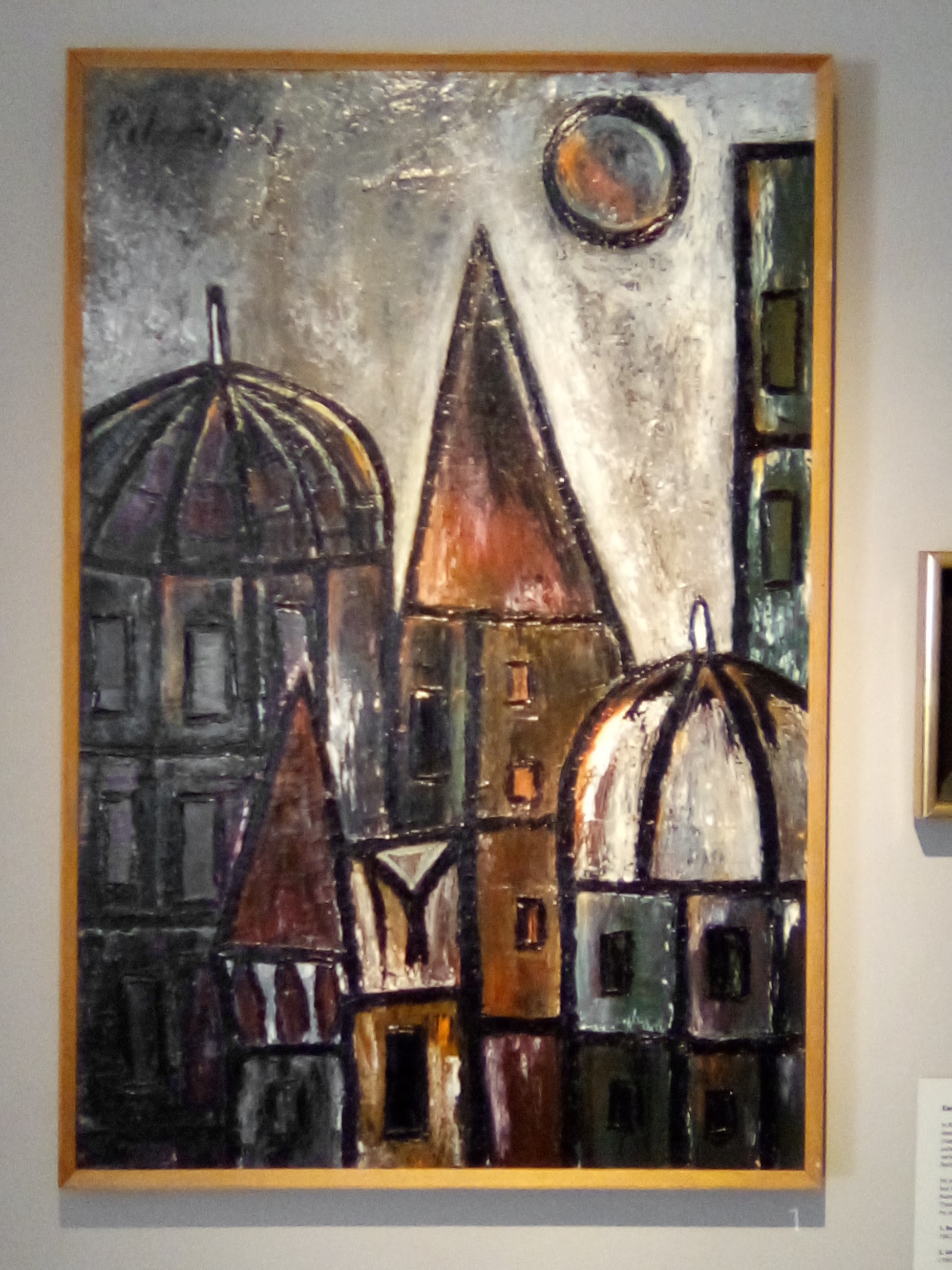
  • Friday was an absolutely gorgeous autumn day, so I decided to make the most of it by mooching around Hampstead and across the Heath. My first stop was Burgh House, which I'd visited before. The house itself, though old, is not a house museum per se, but a building owned by the local council and used for events, exhibitions, talks, music performances, etc. They keep it going on income from the busy cafe, ticketed events and from renting it out as a popular wedding venue. Art exhibitions, usually featuring artists with ties to the NW3 area, are free. I went to see Finding Joy in a Landscape, the paintings of Lancelot Ribiero, a man originally from Goa who settled in Belsize Park and had his studio just one street over from where I'm staying. His colourful paintings filled me with joy and made me eager to explore Hampstead Heath, despite my sore throat and running nose. 

  • The higher I got in altitude as I walked up the Heath, the clearer my sinuses felt. Maybe it was the sunshine and warm air, or maybe I was escaping the pollution of downhill London, just as people have been doing for hundreds of years since they first fled the city's filth to take in the clean water and atmosphere of Hampstead. My next stop was Kenwood House (another free venue) at the top of the Heath, which I reached up the western pathways with the aid of Google maps. Along the way, I occasionally passed other walkers, many with dogs, but often had the paths to myself. I thought I would be able to hear nothing but the rustle of leaves, birdsong and scampering squirrels, and there were brief moments when this was the case, but most of the time I could hear the sounds of civilization encroaching on the wildness -- jets roaring overhead and sirens wailing (probably ambulances headed to the Royal Free Hospital below in Pond Street). Kenwood has tons of old masters paintings hung on the walls all the time, but at the moment they've hung 17 paintings by Joshua Reynolds, some having undergone recent conservation, in an exhibition to mark 300 years since his birth. What a difference it makes to visit Kenwood on a weekday! My previous two visits had been on a Saturday and a Sunday, both on warm, sunny days when people were out in droves. While this day the outdoor patio of the cafe was full of people -- and many babies in pushchairs -- the rooms indoor were not at all crowded and there wasn't a school kid in sight. 
  • My final Friday destination was Keats House in the southern part of Hampstead (South End Green, near the Hampstead Heath overground station). Wanting to get there from Kenwood House by the quickest way possible, and not trusting my navigation skills in wild and wooded terrain, I pulled up CityMapper on my phone and asked it to give me the fastest route. Phone in hand, and keeping a steady eye on my blue dot as I moved down the Heath, the app took me along legitimate paths and desire lines, across open fields and through woods, getting me to Keats Grove without getting lost. Whew! This was my first visit to this small home where Keats lived prior to going to Italy where he subsequently died of TB. I don't know anything about Keats or about poetry in general, so the reverence people feel for him and this house were lost on me. And, about 15 seconds after entering one of the rooms, I had a terrible allergy attack and dashed out, with watering eyes and coughing like crazy. My entry was free with my ArtPass, so I didn't mind cutting my visit short. 
  • On Sunday, I trekked back up the hills of Hampstead to visit Fenton House and its garden, another first for me. It's a National Trust property, and there's an entry fee unless you are a NT member, but I had managed to score a limited, free pass to NT properties. The house was built in the 17th century, with the gardens laid out much later. Inside the house, though there isn't much furniture, there's a lot to look at -- art on every wall, Chinese and Japanese ceramics filling cabinets in many rooms, embroidery works and a collection of old musical instruments including spinets and harpsichords. In the early 21st century, an actor named Peter Barkworth, who lived locally, donated his art collection -- primarily post-impressionist works of the Camden Town Group -- to the house. I hadn't known about the CTG paintings at Fenton House prior to my visit; if I had, I surely would have come to see them sooner as CTG has long been a favourite of mine. Similar to the Ashcan School in American, the paintings depict everyday life in London and beyond. I really enjoyed both the style and the subject of the works. While the house is lovely, the real showpiece is the walled garden with its vast lawn, holly topiary trees, fruit trees, vegetable patch and flowering beds with autumn blooms. The weather couldn't have been better for this visit. 


During the week, I saw a couple of small art exhibitions at museums and galleries (all free), including:
  • Ed Ruscha: roads and insects prints at the British Museum. I wouldn't hang the ants and cockroaches on my wall, but I did admire these skillful prints, especially the swarming insects casting shadows across the paper.
  • Paula Rego: Letting Loose, paintings from the 1980s at Victoria Miro. Humans and beasts cavort around these large canvasses in what looked like fever dreams to me. It's my first exposure to her work and I can't say I liked these paintings, but I'll be on the lookout for more recent works from her to see how her style has evolved. 


And lastly, a few odds and ends of what I got up to this past week:
  • Rooftop garden at the Post Building in Holborn. Just a few minutes south of the British Museum, this new nine-storey building has a roof terrace that the public can visit for free. It offers great views of Bloomsbury to the north (you can pick out the individual squares with their tree canopies), including St George's Bloomsbury, the BM, Senate House, and further north to Hampstead in the distance, as well as south to the London Eye, the City, and Canary Wharf. In addition to the views, which I enjoyed far more than those from the much higher Sky Garden in the City, the terrace is serene and provides a lovely respite from the hustle of the streets below and the bedlam within the British Museum. 


  • Two "taster" walks as part of London Local Guiding Day. Six of the local guiding associations team up annually to provide free one-hour walks in different parts of town. I did the walks in Islington and King's Cross. 
  • The Primrose Hill Community Association walk was down to Regent's Park to look at the Frieze Sculpture 2023 outdoor exhibition this past week. Since I neglected to take photos on my phone the first time I saw the sculptures, this time I took some snaps for you all to see. 


  • I saw the play Anthropology at the Hampstead Theatre. Excellent acting and staging, engrossing plot about artificial intelligence and family dynamics.

The stats for week three:

Monday:
£2 tuna & sweet corn sandwich
£1.80 pastel de nata
£3.50 Guildhall Art Gallery (ArtPass concession price)
14,732 steps
6.05 miles

Tuesday:
£3.55 lunch
17,019 steps
6,96 miles

Wednesday:
£4.70 farmers' market
£12.60 groceries & wine
£2.85 sandwich
£6 bread from Panzer's
£1.50 cookie
22,688 steps
9.37 miles

Thursday:
£26 Hampstead Theatre ticket (OAP matinee price)
£1.75 throat lozenges
19,090 steps
9.37 miles

Friday:
£1.75 sandwich
£2.50 cookie
£6.93 groceries
£2.35 Boots
21,495 steps
8.78 miles

Saturday:
£11.10 farmers' market
£2.75 yoghurt
£4.05 more throat lozenges 
21,555 steps
8.93 miles

Sunday:
£2.45 pain au raisin
£.90 packet of Fisherman's Friend
16,879 steps
6.94 miles


Monday, October 02, 2023

Second Week: More art and many walks

Now that I've settled into my London routine, I thought I'd tell you a bit about that and how I organize my time. I've found I like to alternate days of time spent on my own rambling and taking photos with days involving activities with friends. If I spend too much time on my own, restorative as that is, I miss the company of my mates, though I do tend to chatter like a magpie when I eventually meet up with people after chunks of silent time. However, as an introvert by nature, I need the solitary time and there's nothing I like more than walking, getting lost and discovering new things and places along the way. 

As I'm doing my pre-trip research and planning throughout the year, I keep an ongoing spreadsheet listing the places and exhibitions I want to see, along with columns for any specific dates that something might be on, the postcode of the location, and notes about opening times and prices. I usually sort the spreadsheet by postcode. Once I've book a ticket for something -- an exhibition or a guided walk -- or planned a meetup, I look to the spreadsheet and Google maps to see if there are other places in the same or nearby postcode that I can work in before or after the planned event. For example, I had made plans to meet up on Tuesday afternoon with my friend Malcolm to see the Frieze Sculpture 2023 in Regent's Park. Since Bloomsbury is due east of there, I decided to take the tube to Euston station that morning and mooch my way westward, first visiting the Foundling Museum, then eating my packed lunch in Tavistock Square, and popping into the Petrie Museum for a quick look at some of the Egyptian artifacts before a fast walk to our meeting place Great Portland Street station, arriving only two minutes late (a miracle for me as I always underestimate walking times). 

Or, on a wide-open day like Wednesday, here's how I filled it up: I had errands to do in the morning (the weekly Swiss Cottage Farmers' Market, the magic money machine at NatWest in the Finchley Road, Waitrose for some other grocery purchases). I ate lunch back at the flat at noon, by which time the air had warmed up and, though overcast, it looked to be a pretty decent day. With nothing else on my itinerary, I decided I fancied a walk down to the canal and west on the towpath, something I hadn't done for many years. I ended up walking to Little Venice, on to Paddington Basin, catching the tube from Paddington to Maida Vale, and then zig-zagging my way on foot to St John's Wood. I had dropped several "Want to Go" pins around the area on Google maps (I've set these pins all across London), so I pulled up Google maps on my phone and had a butcher's at those nearby pinned items -- a giant bath plug and the rolling bridge at Paddington Basin, and in Maida Vale a double-height red phone box (public art) and a lovely tiled panel on a Victorian dairy. Before getting back on the tube to Swiss Cottage, I stopped into Panzer's Deli in St John's Wood (pinned as "Favourite" in Google maps) to buy a loaf of their fabulous rye, raisin and walnut bread. The rest of my week was a similar combination of planned activities and serendipity.  

Week Two found me doing more art exhibitions, some historical things, and several guided walks. First up, here's the arty stuff I saw (or didn't, as the case may be):

  • Paul McCartney Photographs 1963-64: Eyes of the Storm at the National Portrait Gallery. I'm not a huge fan of the Beatles (I'm much more "Let it Bleed" than "Let it Be") so I went to this exhibition somewhat reluctantly at the behest of my friend Molly. Expecting to see a bunch of amateur snaps, I was pleasantly surprised to find that, at the time these photos were taken, McCartney was working hard to develop a good eye and composition technique, learning a lot from his photographer brother Mike and from the many photographers who traveled with the Beatles during that year. After viewing the extensive exhibition, covering the group on tour in Britain, Paris, New York and Miami, I exited through the gift shop and bought Molly a book and postcard. I spent a little more time at the NPG, looking at the galleries of portraits from 2000 to present, including self-portraits of women, contemporary commissions and "Making a Modern Nation."


  • The Mother and the Weaver at the Foundling Museum. This exhibition, in one of my favourite museums (free with my Art Pass), featured 40 works of modern and contemporary art by women, all of which come from the collection of Ursula Hauser, a great collector of women's art. Many of the pieces are by Louise Bourgeois, whose work I love, and there were other pieces by artists who I recognized. 

  • Search History by Paul Stephenson and Niña by Sofia Enriquez, both at the StolenSpace Gallery in Shoreditch on Friday. I'd never been to this underground art gallery before -- it's small, but has done interesting shows. I'll be sure to return on future visits. 
  • Continuing up Brick Lane from the StolenSpace Gallery, I turned into Heneage Street to go to the newly-opened Gilbert and George Centre, only to find building work going on and the gallery closed for the week. Thoroughly gutted, I proceeded on up Brick Lane. 
  • Ghost Lines by Dan Kitchener (DANK) at the Brick Lane Gallery. I've been watching DANK paint on the streets of London for years and enjoyed seeing this exhibition of his signature street scene reflections. 
  • Not an exhibition per se, but I popped into Nelly Duff, a print gallery in Columbia Road to see what was on the walls. I really liked several prints -- by Shepard Fairey, Jo Peel and Eine in particular -- hanging there. 
  • Modernism at the Mall, a small exhibit at the Isokon Gallery about the artists who lived and worked in the nearby Mall Studios. Many of them, including Barbara Hepworth, shaped modernism in British art. The exhibition is mostly text boards, but they were showing a great companion video about a visit to the studio home of sculptor and printmaker Celia Scott who still lives and works there.
  • On Sunday I briefly visited the Conservatory at the Barbican Centre. The conservatory is generally open to the public at select times, the rest of the time (I think) being available to residents of the Barbican Estate and/or hired out for private functions. From October 1, there's a site-specific installation called Cloud songs on the horizon by Ranjani Shettar, featuring six large sculptures spread throughout the huge conservatory. Tickets are free but you have to book a time online and they are going like hotcakes. I'm happy to report that, for the first time ever, I made it into and out of the Bloody Barbican without getting lost. 


There was also the aforementioned Frieze Sculpture 2023, but all the photos I took were on my proper camera. Since Regent's Park is near to my gaff, I'll pop down again and take some photos on my burner phone so I can drop them into a future blog post. 

I also took in some history this past week:
  • Unforgotten Lives at the London Metropolitan Archives -- an exhibition of stories of Londoners of African, Caribbean, Asian and Indigenous heritage who lived and worked in the city between 1560 and 1860. There's an enormous amount of wall text to make it through, but I chose the stories I wanted to read and found those all very interesting and compelling. 
  • A brief stop at the Petrie Museum of Egyptian Archaeology at University College London. This small museum holds thousands of artifacts, only a fraction of which are on display, excavated in the early 1900s and donated to UCL. It was more than I could take in, but I did enjoy looking at the jewelry and was astounded to see three dresses that had been painstakingly conserved and reconstructed from fragments. 
  • On Friday, at the northern end of my walk from Aldgate and up Brick Lane to Columbia Road, I pushed on and visited the Museum of the Home (formerly the Geffrye Museum). Not much has changed since inside I was last there nearly 20 years ago (except for adding some more inclusive stories to the rooms), but since then they've opened a really lovely garden in the back. 
And finally, the THREE fantastic guided walks I went on:
  • Ghostsigns of Islington, led by my friend Jane Parker who does her guiding through Footprints of London. Anyone who looks at my photos on ipernity will know that ghostsigns have long been a keen interest of mine, so it was delightful to do this walk with Jane. I always learn so much about commerce, industry and everyday life in London through these signs, many of which are at least 100 years old. Often, a prime sign space is used over and over by different commercial endeavors -- as the years and the elements erode the layers of paint, it's like peeling back layers of time. Along the way, I saw parts of Islington that I knew and many spots that were new to me.

  • Lost Monasteries of Clerkenwell, led by another friend, Lesley Thompson, who leads walks through Islington Guided Walks and independently. Again, this was an opportunity for me to revisit some familiar sites, learning about aspects of Clerkenwell and its history that I hadn't known. Lesley skillfully led us around the remains of the medieval monasteries of St Bartholomew, St John, the Charterhouse, and the nunnery of St Mary, evoking a sense of what these places were like before and after the dissolution of the monasteries under Henry VIII. It amazes me that so much medieval stuff -- from fragments of walls to entire buildings -- has survived to this day and that these institutions still have an impact on London life. 
  • From Monoux and Morris to Beer and Bacon Jam, a walk around Walthamstow led by Joanna Moncrieff, also a Footprints of London guide, who I met for the first time on this tour. Again, this was a walk in an area I'd been before (but not since 2004!) and I got to see it with fresh eyes through the tour. Walthamstow has changed dramatically over the past nearly 20 years, but I recognized many places I'd seen before. Since gentrification, there's been a lot of new builds and refurbs. The stops along the route illustrated the rich history of the area. It was a fun tour -- and we saw not one but two almshouses! (I do love an almshouse as much as a ghostsign.) We started the walk at the William Morris Gallery and ended at God's Own Junkyard, a collection of neon signs many from former sex shops in Soho.


There's not much to say, let along complain about, regarding the weather. It chucked down rain a few times during my first week, but there was none during the second. It's primarily been overcast, with sunshine and blue skies occasionally. Temps have been in the mid-60s F every day. While rain has not been dropping out of the sky, the conkers have been! I started seeing them on the ground four or five days ago. I can't resist picking up the fresh, shiny ones and stuffing them into my pockets.


The stats:

Monday:
£11 Paul McCartney at the NPG (Art Pass price)
£2.30 pastel de nata
£ merch for Molly
15,738 steps
6.39 miles

Tuesday:
£3.50 slice of cake
£6 loaf of bread from Panzer's
18,213 steps
7.48 miles

Wednesday:
£10.30 groceries
£9.85 wine
£2 cookie
25,238 steps
10.32 miles

Thursday:
£10 Islington walk
£2.05 lunch (Forgotten Ends sushi from Waitrose)
£12.13 groceries
17,521 steps
7.22 miles

Friday:
£3 banana bread
19,800 steps
8.01 miles

Saturday:
£12.50 farmers' market
£11.07 groceries and wine
£15 Clerkenwell walk
£6 tea with Lesley
£20 to top up Oyster card (for out of zone 1-2 journeys)
18,088 steps
7.38 miles

Sunday:
£10 Walthamstow walk
£2.80 flapjack
16,877 steps
6.91 miles