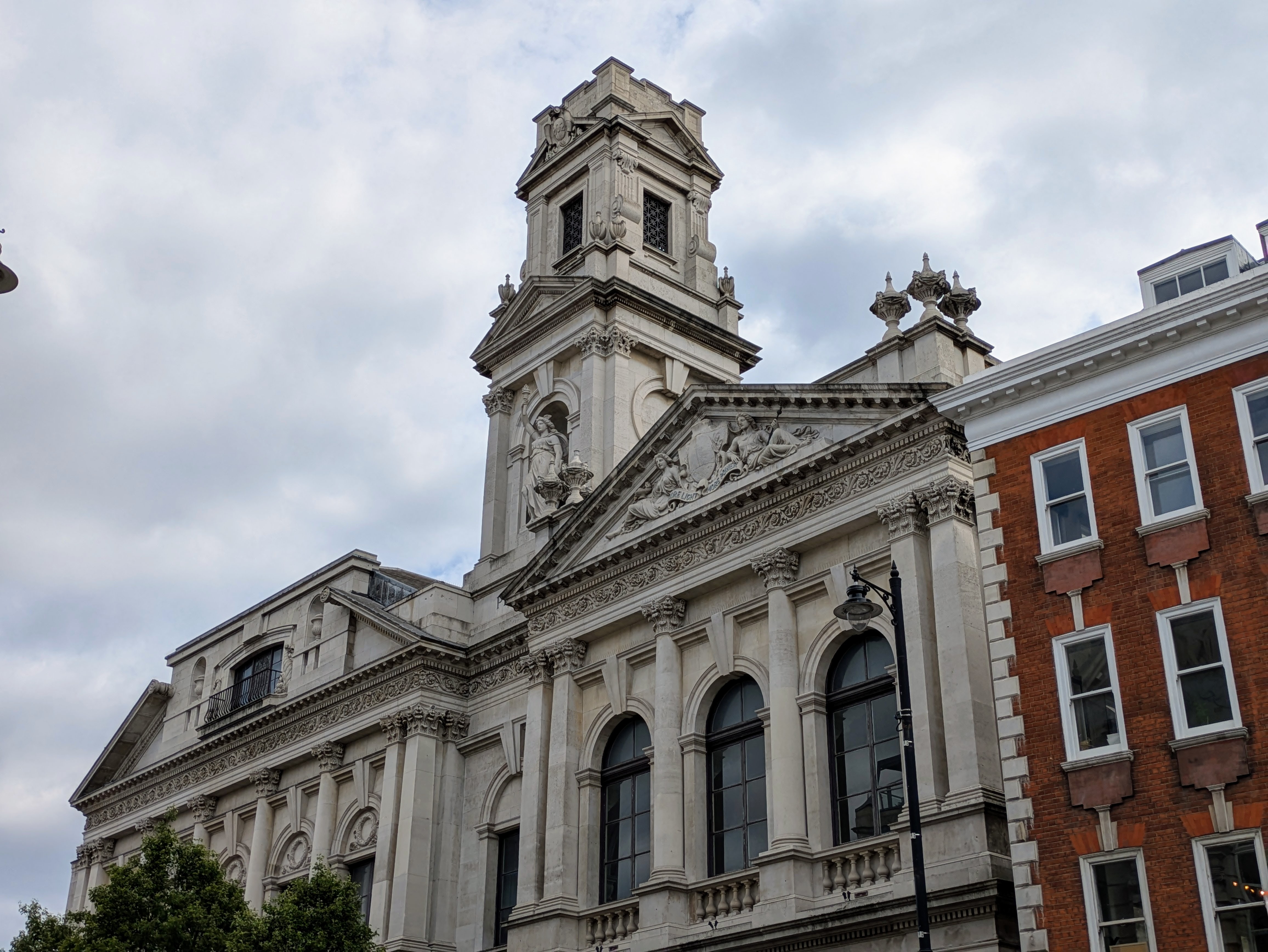
It's bloomin' lovely here!
I am back in Blighty, from whence I am channeling my inner Dickens in order to describe for you the sights, sounds and smells of the streets of London. But if my attempts at great literature fall short (and surely they will), I'll channel my inner Bill Bryson to regail you with Tales of Tourism in which I'll detail my misadventures and provide ample commentary on the differences between our two English-speaking cultures, separated by a vast ocean.
The trip across the pond, via Dublin as usual, was looooooong but uneventful. The only thing of note was the number of questions fired at me from the woman at UK immigration & border control. At 4 in the morning, I'm pretty groggy but usually able to respond that I'm on holiday, staying in London for five weeks. This time through, I was asked what I'd be doing for that long time, (seeing art exhibitions and going to theatre), what type of accommodation I'd be staying in (AirBnB), and to show my return ticket. I really hadn't expected that last question as I'd never been asked before, so I didn't have it ready to show on my phone. But I found my reservation, showed it to her, and then was waved through. Unfortunately, I didn't get a minute of kip on the plane, owing to the discourteous behaviour of my fellow (American) passengers. Nuff said about that.
In the afternoon of my arrival day (Thursday), after unpacking, setting up all my tech, and unrolling my yoga mat (stashed year-to-year at the AirBnB) for a bit of stretching, I had the delight of showing Belsize Park to some mates from America. My friends Betsy and Jim, whose son and young family moved to Hampstead 18 months ago, arrived on the same day as me (different flight) and are staying for the first time in Belsize Park, though this is not their first visit to NW3. Late in the afternoon, I met them at their gaff (three blocks from mine) and showed them some of the key sights -- Eton Avenue (the loveliest street in London) with the Hampstead Theatre and the weekly farmers' market at the Finchley Road end, the Washington pub, the best charity shop (Mind), Boots, Daunt Books, and a few of the grocery stores in Haverstock Hill. Between stops I blathered on about the history of the area, pointing out the architecture styles and other bits both historic and folkloric, including the ever-changing crocheted postbox topper in England's Lane (currently an Easter theme: Be the change you want to see).

After sleeping 10 hours on Thursday night, I thought I'd be ready to hit the road with all my wits about me on Friday. How quickly I was proved wrong, when I went to the Belsize Park station and got on the Northern Line when I'd meant to be going to Swiss Cottage for the Jubilee Line. Chagrined by my stupidity and cockiness, I got off at Euston and tried to figure out how to reroute myself. I'd been planning to go first to the Holland Park station on the Central Line and then walking a short distance to the Piano Nobile Gallery for the Barbara Hepworth exhibition before strolling through Holland Park to Leighton House. It was clear that the Hepworths would have to wait (the exhibition is on for a bit longer) and that I needed to head straight to Leighton House for the Frederic Leighton landscape exhibition that was ending at the weekend. The silver lining of my screw-up was that I had more time for the Leighton exhibition, which was well-worth the ability to do a thoughtful examination of his landscape subjects and techniques. He traveled widely, to Italy, France, Egypt, Ireland, Scotland and other destinations, sketching with pencil, watercolor and paint in every location. Although he often had these sketches on the wall in his Holland Park studio, using them as inspiration for the background in his larger paintings, they were never meant for public display. This opportunity to have a glipse at his private work felt like a real privilege.
I then strolled into Holland Park to look at the tulip beds in the Dutch Garden and to have the first of what will be many, many pita and hummus sandwiches eaten while sat on a park bench. I could have stayed much longer, but needed to push on, back into central London to meet a friend at the Courtauld Gallery for the exhibition Goya to Impressionism. The exhibition features 25 works, all of them top-notch, originally owned by the Swiss art collector Oskar Reinhart. Some of the paintings haven't been out of Switzerland for yonks (if ever) and several I remember from my Art 100 course in college. After taking a look at the Nelson Staircase, we left Somerset House and made our way towards Charing Cross, stopping at The Ship and Shovell where I bought a round of half pints of Badger Brewery Fursty Ferret. High marks!
On Saturday, I sent myself on a day trip to Chichester, a cathedral city south of London in West Sussex. First up, I visited the Pallant House, a lovely gallery housed in a Grade I listed 18th century townhouse with a modern extension. The gallery specializes in modern British art, with a collection said to be second only to Tate Britain. Only a fraction of what they hold is on display at any time, and they have excellent temporary exhibitions. I had a butcher's at a small exhibition of paintings by Maggi Hambling, inspired by nights spent in woodlands listening to the sounds of the creatures who inhabit the night, and thoroughly enjoyed Masterpieces in Miniature: The 2021 Model Art Gallery (tiny works done by contemporary artists during lockdown when they couldn't make or exhibit large pieces). 

These were the icing on the cake, as the real purpose of my visit was to see Dora Carrington: Beyond Bloomsbury. She was a less prolific (making personal works rather than focusing on exhibiting) and perhaps the least known of the Bloomsbury set, but certainly no slouch in the talent department. The works in the extensive exhibition covered her short lifetime, from drawings done when she first enrolled at the Slade School of Art as a teenager, up to her death at the age of 38. Her free-spirited bohemian lifestyle was a bit hard to keep track of, with the members of her set changing partners of both sexes in rapid succession (there was a timeline on the wall that attempted to sort it out). Throughout her life, her artsy friends and lovers provided inspiration and subject matter for her painting. The works were stunning and I hope now she'll claw back some attention from those better-known Bloomsberries.


It was a gorgeous, sunny day and perfect for a ramble around the town in search of streetart, followed by a stroll through the Bishop's Palace Garden (with obligatory sandwich et on a bench), a walk along the top of bit of the Roman wall, and a quick stop for a look around Chichester Cathedral. Before heading back to the train, I met up with a Facebook friend -- someone I'd known online for over a decade but had never met IRL -- at a local caff. All in all, a most excellent day trip.
Since I had to miss the Saturday farmers' market on Parliament Hill, I started my Sunday adventures by taking the bus down to the Marylebone Farmers' Market in order to buy two pies (spinach & feta and spicy potato) from my favourite pie vendor, Sires Hill Bakery, and a hot cross bun for my mid-day snack. My pies and I then headed to the other side of the Euston Road to follow the new Regent's Park Estate Story Trail. I'd heard about the trail on the radio and thought it would make for a good, low-key Sunday option. The trail is a series of art pieces, made by local artists and/or the community, that relate to the culture, ecology and heritage of this very large estate (population 12,000 in 2000 homes/49 buildings). I'd been on the perimeter of the estate before (the Euston Road, Albany Street, Hampstead Road) but hadn't walked around inside it. The architecture of the buildings varies so it doesn't have that monolithic and intimidating look of many social housing estates. On this quiet Sunday, it made for an interesting ramble (some of the installations more interesting than others). I wrapped up my afternoon with walk through Regent's Park (by contrast very crowded), up Primrose Hill Road and back to my gaff to heat up one of the pies for me suppa.
I began on Monday to make my way around London to a slew of exhibitions, prioritizing the ones ending soon, and beginning with The 80s: Photographing Britain at Tate Britain. This exhibition covered EVERYTHING: politics, racial tensions, strikes, gay and women's rights, AIDS, the economy, Thatcher, consumerism, leisure, etc., etc. Enlightening, powerful and impressive, but way too much for my little brain to take in. A friend said the Tate couldn't decide if it was a history or a photography exhibition.
I spent that afternoon seeing a small exhibition about black music at the Barbican Library, a display about Dick Whittington ("a rags-to-riches tale of penniless orphan who came by wealth and fame with the help of his cat") at the Guildhall Library, and the exhibition Evelyn De Morgan: The Modern Painter in Victorian London at the Guildhall Art Gallery. Like Dora Carrington (although a decade older), Evelyn De Morgan studied at the Slade while in her teens and did life drawings that looked remarkably like those of Carrington. But the similarities ended there. I think Carrington was the real "modern" painter, while De Morgan was distinctly Victorian in her style and subjects, which reminded me a lot of George Frederic Watts and William Morris, who were friends of hers. I prefer Carrington any day.
That evening, I stayed in the City for Curious Histories, an event consisting of three talks on peculiar tales from history. I listened to the talks about Victorian postmortem inquests and highwaywomen, but skipped the one on Shakespeare. It was a long day.On Tuesday, I took in three soon-to-close exhibitions, startings with Flowers in Contemporary Art and Culture at the Saatchi Gallery in Sloane Square. This is one of the spring blockbusters (the exhibition has been extended) and it was heaving with people including -- the horror! -- a group of about 20 primary school lads. The exhibition was incoherent (anything with a flower in it was acceptable, apparently), ostentatious, and reminded me of everything I dislike about Chelsea, i.e. more concern with style than substance.
The day's other stops were Piano Nobile Gallery in Notting Hill to see Barbara Hepworth: Strings (I wonder if she created any of the pieces when she lived in the Mall Studios near my gaff) and an exhibition about tarot cards at the Warburg Institute in Bloomsbury. 

Having had my fill of art over the past few days, I spent Wednesday in search of bluebells in a peaceful woodland setting. I took the bus to Highgate Station (good plan, as it would have been an uphill slog to walk from Archway) and then walked up, up, up Muswell Hill Road into Highgate Wood. With legs aching from the climb, I found myself under a canopy of trees with bluebells, dappled with sunshine, spread out in a carpet. Lovely. Pita and hummus sandwich eaten while sat on a bench. The woods were cool -- a welcome respite from the heatwave going on across Britain, with an all-time high temperature reading in Central London. Since it was mostly downhill to get anywhere from there, I walked down (yay!) North Hill, passing High Point (a residential blocks designed by Berthold Lubetkin, built in the 1930s on one of the highest points in London) and down to Highgate School where I caught the bus (full of school kids) back to Belsize Park.


Thursday was May Day, and what better way to spend it than leading my friends Betsy and Jim around Clerkenwell to see sites of rebellion and revolution. We started at the Angel, followed the path of the New River to Spa Fields, stopped at the London Archives (exhibition on London during the second World War), and pushed on to Clerkenwell Green. The Karl Marx Library was having an open house (I'd never been inside before) while lefties of all stripes were assembling outside, awaiting the step-off of the annual May Day March to Trafalgar Square. We enjoyed talking with one of the enthusiastic library volunteers who made me promise to come back again for one of their tours.


Lunch was take-away tuna sandwiches from Scotti's Snack Bar in Clerkenwell Green. My idea had been to eat them in the cloister garden of St John Priory Church, near St John's Gate, but the gates of the garden were chained shut and we had to seek out an alternative. This ended up being sharing a low wall with three blokes in St John's Garden in Benjamin Street -- a nice spot but a bit crowded with people from the nearby offices who were enjoying the nice day by lunching al fresco. After lunch, we zipped around to take in more history -- St Bart's the Great, Cloth Fair, Postman's Park and bits of the Roman Wall before getting the tube at Moorgate.
I had promised Betsy & Jim a 2-3 mile walk -- it ended up being more like 4 or so. Ooops. But it was such a nice hot day that the purple haired Energizer Bunny (me) just kept going and going. And so I did, even after seeing them back to their gaff. I made myself an early supper and headed down through Regent's Park to the Royal College of Physicians, where they were having their monthly Thursday lates, with tours of the garden and a chance to learn more about medicinal plants. There's also a small exhibition of recipe (or receipt) books from 1500-1800 inside. These hand-written journals were kept by and for women, often passed down for generations, detailing ways to use plants for healing along with culinary recipes, advice on preserving food, keeping house, etc.
On Friday, I was up and out of the flat early to take the train to Sydenham, where I met up with friends David and Janie for what has come to be an annual day trip adventure during my London stay. We usually go to someplace that I haven't been (and sometimes they haven't either) that would be difficult or impossible for me to reach via public transportation. Last year we saw the gardens of Vanessa Bell and Virginia Woolf. Carrying on with the Bloomsberries, this year we went to Sissinghurst, the home and vast gardens of Vita Sackville-West in Cranbrook, Kent. I'd seen a couple YouTube videos about the gardens, and had heard that they were spectacular, but I wasn't prepared for just how exceptionally splendid they would be. It was another drop-dead gorgeous day -- a bit cooler than the two previous ones -- with blue skies and sunshine galore. The gardens feature room after room of blooming treats for the senses. I'm not all that good at identifying plants, but I know I saw wisteria, anemones, poppies, roses, ranunculus, trillium, bluebells, and lots more. One "room" is a white garden and another is all oranges and yellows. There's even a marvelous vegetable garden, meticulously kept, with various trial beds of different plant varieties and organic gardening techniques. The whole place was buzzing with bees that obviously were having the time of their short lives.


Keeping with the garden theme, and not wanting to waste what would be the last hot, sunny day for a while, I spent all of Saturday outdoors. First, I put a load of clothes in the washer. Then I walked up to the Parliament Hill Farmers' Market where I got some of my favourite items (bread, olive bread sticks, a corn fritter, aubergine and red pepper tart, and a samosa) and caught the bus back to hang my clothes on the airing rack. Then I took another bus to the west Heath and walked a few yards to the Hill Garden and Pergola. Last time I was there, it was late autumn, grey and gloomy, and I got caught in a downpour. This time, the purple and white wisteria was dripping from the long pergola and a cascade of various coloured rhodedendrons tumbled down a hillside. After enjoying the elevated pergola and the gardens below, I walked down through a bit of Hampstead Heath to the Vale of Health, a small cluster of charming cottages tucked away in its own enclave.
And now it's a cold, windy Sunday with lower temps forecast for the next few days. I stayed inside in the morning, banging out this post, then hustled into town for a bit more art: Yayoi Kusama and Niki de Saint Phalle at the Opera Gallery, a super exhibit of Peter Mitchell's photos at the Photographers' Gallery, and an exhibition of cats in cartoons at the Cartoon Museum.
The day ended over pints with my hosts at The Lord Southampton (recently brought back from the dead and reopened as a very nice local boozer on the Kentish Town side of Belsize Park).I've got lots of good stuff planned for the upcoming week, so stay tuned. I'll try to be better about blogging more often.
Stats:
Thursday:
€3 tea at Dublin airport
£16.19 groceries, wine, toiletries from Budgen's
£10.94 groceries from Nisa Local
14,506 steps
5.95 miles
Friday:
£50 top up Oyster card
£6.50 beers at Ship & Shovell
£5.47 groceries
Leighton House free with Art Pass
Courtauld Gallery -- used David's extra ticket
16,252 steps
6,71 miles
Saturday:
£14.79 train to Chichester
£6.25 Pallant House (half price with Art Pass)
£7.99 salad for dinner
18,396 steps
7.54 miles
Sunday:
£1.75 hot cross bun
£8 pies (2) from Sire's Hill at farmers' market
£3.99 bread
£4.19 groceries
20,698 steps
8.49 miles
Monday:
£10 Tate Britain (half price with Art Pass)
£5 Curious Histories event
£1.15 pastel de nata
£2.45 Forgotten Ends from Waitrose
£6.45 beer at event
25,001 steps
10.25 miles
Tuesday:
£10 Saatchi Gallery (concession price)
£.75 Lockets (lozenges)
£2.75 cookie
£3.40 groceries
17,061 steps
7 miles
Wednesday:
£5.99 bread at Panzer's
£3.40 farmers' market
£2 flapjack
£3.50 t-shirt from charity shop
£10.50 wine
£171.70 one-month zones 1-2 travel card
21,752 steps
10.61 miles
Thursday:
£3.75 groceries
25,873 steps
10.61 miles
Friday:
13,625 steps
5.59 miles
Saturday:
£16.40 farmers' market
19,060 steps
7.82 miles
Sunday:
£4.25 Photographers' Gallery (half price with Art Pass
£7.50 book from Photographers' Gallery
Cartoon Museum free with Art Pass
£2.50 groceries
19,040 steps
7.82 miles