Tuesday, May 20, 2025

Travel tips & dispatch #3


A new postbox topper appeared this week in Belsize Park, this one in Haverstock Hill (the other one is in England's Lane). It features the Jack Russell Terrier called Patron who sniffs out bombs in Ukraine. 

Before I tell you what I got up to during my third full week in London, I thought I'd give you some of my latest travel tips. As you know, I'm all about traveling on the cheap while still having quality experiences. And I'm all about using technology to save time and make my life easier. Let me know in the comments below if you have other budget travel tips or if you find any of these useful.

  • Mobile phone and data -- Years ago, I signed up for international coverage from my home carrier before coming to the UK. Never again! My UK friends didn't like that they couldn't get hold of me on a local number and any calls I received from home cost a lot in roaming charges. I checked my voice mail to find a reminder message from my dentist that cost me about $4 to retrieve. Then, for many years I would get a cheap SIM card from a local carrier and swap the SIMs in my unlocked phone for my time in the UK. That was alright except that my UK number was different every year and it was a bit of a faff to switch the cards. In 2022, I bought a really cheap burner phone in London and used that for two years, being sure to top it up every 179 days between trips in order to keep the phone number. In 2024 I got a new Pixel 7a (unlocked) with dual SIM capacity and it has been a game changer. I ported the UK number to a carrier that offered eSIMs on checkout (i.e. you didn't have to first receive a physical SIM and then request to convert to eSIM). Installation was easy and it's been a breeze to use. I still have to top it up every 179 days, but I've now had the same number for 4 years. In addition to being able to make calls or send texts from that number, I find that many online booking sites require a phone number and they don't like US numbers. But if you don't need a phone number for the country you're visiting, get an international eSIM from Holafly, Saily or Airalo (I haven't tried them and they are not sponsoring this blog) -- you'll have all the data you need for Google maps, communication via WhatsApp or Messenger, etc. at a fraction of what you'd pay to your home provider. You should buy and install an international eSIM before you leave home, then turn it on when you reach your destination country.
  • National Art Pass -- The Art Fund in the UK offers pass cards that allow you free entry into many, many cultural sites as well as 50% off ticketed exhibitions, gift shop and cafe discounts. A one-year pass currently costs £62.25, and they often offer trial cards (3 months for £20). I have saved a shed load of money using my Art Pass, particularly if I can get two trips in during the duration of my card. The only hitch is that you need a UK address for them to mail you the physical card. I've always asked my AirBnB host if I could use their postal address and there has never been a problem doing so.
  • Loyalty cards -- Even if you're going someplace only for a short period of time, loyalty cards can be very beneficial. I now have loyalty cards for Boots, Waitrose, Tesco, Sainsbury (Nectar card) and M&S. All have apps so there's no need to carry a physical card around. Since I cook all my dinners, and take a packed lunch on most days, it's great to be able to save on the cost of groceries. The savings are often substantial if I buy things on special. 
  • Too Good to Go app -- They rescue potential food waste from restaurants, cafes and grocery stores across the US, UK and Europe and make it available via the app at discount prices. Near the end of the day, the vendors will offer a surprise bag -- pastries, sandwiches, meals, etc. -- for pick-up between a narrow window of time before they close. I've used it a few times with mixed success. Sometimes I've really liked the surprise bag, sometimes not so much so. But the prices can't be beat. 
  • Citymapper app -- This app covers public transport in major cities all over the world. It will get you anywhere you need to go by bus, tube, ferry and on foot. 
  • Google Wallet (or whatever the Apple equivalent is) -- It's not just for payments. I use Google Wallet to hold my driving license, COVID vax card (is that needed anymore?), loyalty, healthcare, and library cards. When I'm traveling, it has been an excellent place to keep event tickets. All I have to do is take a screenshot of a confirmation email and add it to Google Wallet. The app does the rest to convert the email, along with the barcode or QR code associated with your ticket, into a ticket in your wallet. 
  • When I took my high school's driver education course, we were shown many short films about road safety, the majority of which involved teenage drivers and crashes. One film, shown to us multiple times, taught us three tips for safe driving. I remember the first two: "Aim high in steering" and "Leave yourself an out." I think these are applicable to any type of travel, by car, public transportation, or on foot. Since the third tip eludes me, I've made up my own, one that I think is the most important travel tip of all: "Know where your next loo stop will be." I have a mental inventory of loos all across London, and I'm always adding to it when I happen upon an especially fine one (see below for Tuesday's recap). But when in doubt, I know I can consult the Toilets4London app on my phone (other apps are available). 
Now for how I spent the past week. I got my act together and planned for Monday, booking ahead of time for two very popular art exhibitions. In the morning, I went to see Grayson Perry: Delusions of Grandeur at the Wallace Collection. It was crowded, but thank the goddess there were no school groups! This is the fourth or fifth Grayson Perry exhibition I've seen and I always enjoy them, particularly when the exhibition tells a story. And for this exhibition, Grayson Perry himself narrates the excellent audio guide (it's really part of the exhibition itself). This three-minute video will give you an idea of what the exhibition is all about. I love that Perry interrogates issues of class and culture in his work, both seriously and with good humour, and in this exhibition he even takes the piss out of the Wallace Collection itself. 


I ate my packed lunch in Brown Hart Gardens in Mayfair (not a part of London that I frequent) and then stopped in at the Leica Store (part camera shop, part gallery) to see photos of celebs in a small exhibition called From the Heart by Canadian filmmaker Douglas Kirkland. 

My afternoon ticket was for Tate Modern to see Do Ho Suh's exhibition Walk the House. Fortunately, I allowed myself plenty of time to get there from Mayfair because, when I descended into Bond Street station, I found myself in a group of about a dozen people waiting to get through the ticket barriers. Members of staff behind the gateline didn't seem to know why the barriers weren't working and were trying to get them reset. After about five minutes, as the group of frustrated passengers got larger, the barriers started accepting cards again and were swinging open. But when the masses reached the top of the escalators, we found that those weren't working either and had to wait another five minutes. I got down one set of moving stairs and headed toward the Jubilee Line, to find the escalator to the platform not working either. People started walking down the stairs, getting half way down when we were met by people walking back up, saying that the trains weren't running. Citymapper gave me an alternative of taking the Central Line to St Paul's, so I headed for that platform. After watching one train zoom through the station without stopping, the next one did stop and opened its doors. Once on, we heard the tannoy announcement saying that the train wouldn't be stopping at the next three stations (Oxford Circus, Tottenham Court Road and Holborn). I got to St Paul's walked over the Milennium Bridge to Tate Modern, and rocked up right at the stroke of three, my appointed hour for entry to the exhibition.

The Korean artist Do Ho Suh is new to me, though when I saw his work I knew I'd seen something of his before (it was called Bridging Home and was part of the Liverpool Biennial in 2010). Home is a big theme for much of his art. For the Tate Modern exhibition, he remembers and reconstructs places he has lived in Korea, the US and London, utilizing rubbings on paper, fabrication in cloth, plastic models, and drawing. There were also some videos, but the only one I watched was one filmed on the Robin Hood Gardens estate in London soon before it was demolished. There was so much to look at and walk through. I'm glad I allowed myself a good long time there.


Back on the street, the sun was shining as I consulted Citymapper for a route home. Most every tube line was showing severe delays due to a power failure on the network. Given what I'd gone through at Bond Street I opted to take the number 1 bus from Waterloo Bridge, figuring it would be better to be stuck on a crowded though moving bus above ground than in a motionless snarl below. As I walked westward to the bus stop, I kept hearing rumblings coming from somewhere behind me, either thunder or airplanes. Each time I heard it, I looked in back of me, first seeing nothing but after about ten minutes of this I could see a clearly demarcated wall of black clouds heading my way. Still no rainfall when I got on the bus, but all hell broke loose when we got to Holborn -- torrential rain, hail the size of peas, and gushing rivers of water in the streets. And as quickly as it started, it was over by the time I reached Belsize Park. 

Most of Tuesday was spent around Kensington with my friend Malcolm. A couple years ago, he took me to Japan House for the first time and now I try to go back there whenever I'm in London. It's part of the Japan Foundation, and is a showcase for Japanese craft and design with an exhibition space (free), cafe (pricey) and shop (very expensive). The exhibition we saw was The Craft of Carpentry -- it was a fascinating, beautiful and mind-boggling show of joinery, timber framing and other wood crafts.


One of the highpoints (for me at least) of the visit to Japan House was the loo. Why had I never used it before? Oh, my! Each loo is a self-contained, touch-free (but for the door) cubicle with fixtures by Toto. As soon as you lock the door behind you, the toilet starts to hum and the seat cover magically raises. Why was I surprised to find that the seat was heated? Of course it was! Next to the sink was a row of buttons that I didn't understand or touch, afraid that one of them might spray water on my bum. After I stood up, the toilet flushed itself and a blue light came on, indicating the start of the cleaning cycle, then hummed again as the lid shut itself. I washed my hands in the touch-free sink (water, soap and hot air all in one), then exited. Wow! This one will definitely go into my mental inventory of London toilets.

I always get a kick out of suggesting a place or activity to do with one of my London mates that turns out to be new for them as well as for me. I suggested to Malcolm that we get take-away lunches from Luba's Green Hut Café on Kensington Road near the Albert Memorial. The caff is one of 13 remaining cab shelters dotted across central London that provide quick, cheap meals to cabbies. They were originally more in number, constructed for the purpose of keeping Victorian horse-drawn-cab drivers from going to pubs to eat, warm up and drink booze before going back on the road. Today, they still serve that purpose. With a tiny kitchen and small dining space inside, only cabbies are allowed to eat in, but the general public is encouraged to order takeaway from the window at the kitchen end of the hut. Each shelter is independently operated, setting its own menu and prices. I'd read great reviews about Luba's and had seen mention that Anthony Bourdain had eaten there and enjoyed his meal. Neither life-long Londoner Malcolm nor I had ever ordered food from one before. We were not disappointed by the quality, quantity or price. And Luba was lovely, chatting to me as she skillfully made sandwiches and cooked omelets at the same time. There were EIGHT cabs parked outside the hut and all eight cabbies could be seen inside, tucking into their lunches and nattering away. 

We ate our lunches while sat on a fallen tree in Kensington Gardens before strolling to the Serpentine Galleries to see the free art exhibitions. The Italian Arte Povera artist Giuseppi Penone's exhibition Thoughts in the Roots was outside and in the south gallery. The man really loves trees. The longer I looked at the sculptures and installations, the more I felt the thoughtful, contemplative aspects of the works. Continuing on to the north gallery, we saw Remembering, a large exhibition of paintings and prints by Indian artist Arpita Singh. According to the website, "Singh’s paintings centre on her emotional and psychological state, drawing from Bengali folk art and Indian stories, interwoven with experiences of social upheaval and global conflict." The paintings were abstract and surreal, with lots of dreamlike and violent images. I liked the tree guy better. 


We strolled along past the Italian Gardens, my favourite part of the park, to Lancaster Gate where I got on the tube. 

My last stop of the day was in the City at the Cutlers' Hall, for a free exhibition of recent work by students of silversmithing from Bishopsland Educational Trust, as part of London Craft Week. I went to see the inside of the livery hall as much as the jewelry and bowls. The hall is impressively filled with all manner of things with blades -- swords, some encrusted with jewels, knives, etc. The students' work was very impressive. And I got a free glass of prosecco as well. 

Wednesday had me back beating the pavement in Islington and Hackney. In the morning, I went on a guided walk with Nigel Smith called "Evolving Islington." (I had gone on his tour of the Union Chapel last year.) I learned about Islington's development from a rural place of pastures, cows and dairies to the bustling area of arts, crafts and commerce we see today ... and everything inbetween. Every time I do a guided walk in Islington, I revisit known places, discover new ones, and fill in more of the connecting tissue -- historical, geographical and psychogeographical. 


After another lunch of Forgotten Ends from Waitrose, ate while sat on a bench in Culpepper Community Garden, followed by a bit of shopping at Muji, I walked down through Clerkenwell, taking a few streets I'd never walked before, to make my way to the Charles Dickens Museum in Bloomsbury. The museum is celebrating its centenary this year with some new exhibitions and a few never-before-seen objects. I breezed past the things I've already seen, spent time over the new bits, and then cooled my heels in their lovely caff while eating a cookie. I always leave vowing to read more Dickens, but I can't say as I have done much other than starting Great Expectations on the plane coming over here. 

I'm not sure how I mustered the strength for an evening guided walk around Hoxton, another event in the programme of the Hackney History Festival. Starting and ending at Hoxton Station, a large group of us traipsed around a geographically small but historically deep loop through this section of what was the vestry or parish of Shoreditch before it was subsumed into Hackney. Again, the walk was a mix of places I've been and new ones, with more layers of history poured over it all. 


Happily, my Thursday schedule was less strenuous and had me sitting down for a lot of it once I got the intitial part out of the way. I was out of the house at a reasonable hour to walk up, up, up to the Freud Museum in Hampstead, just east of the Finchley Road. I hadn't been to visit Freud's final home in London since 2004, and the place has been spruced up a lot since that initial visit. They used the COVID years to modernize and professionalize various aspects of their operation. Although rooms are the same, and Freud's study is just as it always was, musty smell and all, the house didn't seem as cramped as I remember it being. The upstairs is now utilized for exhibits on Anna Freud (I don't recall seeing that 20 years ago) and they have started doing some temporary exhibitions. The current one is by ceramicist Holly Stevenson, who I recognized as having a piece called The Debate in Frieze Sculpture 2023. For this exhibition, called Tracing the Irretracable, she created small ceramic pieces that are humorus, surrealistic and related to Freud's interpretation of dreams. 


I then did a bit of grocery shopping (Waitrose on the Finchley Road) and went back to the flat for lunch before going to a matinee performance of David Mamet's House of Games at the Hampstead Theatre. Meh. I gather it was supposed to be a thriller, but I could see right through every bit of it. 

After a quick, early supper at the flat, I walked to the nearby Isokon Gallery to hear a talk on modern architecture. Massachusetts resident Dana Robbat was in London to speak about Walter Gropius, John Quincy Adams (the architect, descendant of the president with the same name) and modern architecture in the suburban town of Lincoln, Massachusetts. I confessed to her that I'd never been to the Gropius house in Lincoln, and swore to rectify that soon. The talk was very interesting and came with a free glass of wine. 

Friday brought another first for me, along with my friends David and Janie. I took the tube to Clapham Common (uncharted territory in south London) and walked to Wandsworth Road to meet them at the home of Khadambi Asalache, a Kenyan artist and poet who, over the course of many years, decorated the interior of his Georgian house with intricate wood carvings. Due to the fragility of the carvings, only six people are allowed into the house at a time. Donning our slippers (as required), we spent an hour with guides who knew every inch of the house from top to bottom. No photography is allow inside, per Mr. Asalache's instructions before his death, but there are plenty in this article

My afternoon was spent back in town, hopping from one pop-up to another (most them part of London Craft Week). I saw Secret Ceramics at Christie's, an open day display of William Morris books at the Society of Antiquaries, new contemporary crafts in Bloomsbury, a small (and disappointing) display of Lee Miller photos of Egypt at the Petrie Museum, and tea pots in Clerkenwell. 


Was I knackered? Oh, yes. But I went back to my gaff, made a quick supper, and got back on the overground for Hackney Central. I had a ticket for the Hackney Empire to see poets Henry Normal and Brian Bilston. The Empire is an amazing venue, designed by Frank Matcham (he designed the London Coliseum, the Palladium, and a bunch of other theatres) and has a rich history. I loved just sitting in the dress circle, gawping at all the Victorian detail around me. Each poet had an hour on stage, reading poems, telling stories, making us laugh and touching our hearts. It was an excellent show, even if it made for an extremely long day. 


For the weekend, I wanted to cut myself some slack and not have to be anywhere at an appointed time. And I wanted to avoid central London. On Saturday, I walked to and across the western part of Hampstead Heath. I was in search of blue plaques (Daphne du Maurier, Richard Burton, Elizabeth Taylor and Paul Robeson) and the dairy of Kenwood House. I found them all, though I can't say I really saw Liz Taylor's plaque as it's behind some greenery, high up on a huge house with a massive gate and a long driveway. The highpoint of my evening was a long soak in a hot tub.


Sunday was laundry day. While my clothes were in the washer, I started writing this blog and did a bit of planning for the upcoming week. Once I had hung the clothes on the airing rack, I was out the door and heading down to Primrose Hill to catch a bit of the annual spring community fair, which turned out to be much bigger and more crowded than I had expected. Regent's Park Road and a few smaller streets were blocked off and filled with fairground rides, food trucks, vendor stalls and a dog judging contest. I made a beeline through the throngs to the community library where there was a book and bake sale going on. I bought one of each -- a book on Marx in London and a piece of ginger cake. While trying to find a route out of the crowd, I felt a tap on my back and turned around to see a lovely woman who I had met a few years ago through the Primrose Hill Community Association walks. It was certainly a first to run into someone I knew in London by chance in the street! Doro and I chatted for a few minutes and I promised to drop her a line when I'm back in 2026 so we can meet for coffee or a walk. 

I rounded out the afternoon by taking the bus to Notting Hill for an open garden day at the Arundel and Elgin Gardens. This is one of those gated gardens that only neighbouring key holders can access except on open days. The five quid admission fee went to benefit the National Garden Scheme. I then made my way across Portobello Road (heaving with tourists) and meandered through streets of Notting Hill and Bayswater, catching the bus home near Westbourne Park station. 


The sun now rises at 5 am and sets a few minutes before 9 pm, which is a lovely change from when I visit in the autumn. Except for that hailstorm on Monday, the weather has been decent. We've had some days that have been a bit cool, and I've worn the puffer jacket a few more times when I've gone out at night, but I really can't complain. The coming week looks to be warm but overcast. I'll be off to the seaside (Margate) on the 23rd, so fingers crossed for a nice day. Stay tuned for the next update. 

Stats:

Monday:
£7 Grayson Perry at Wallace Collection (half price with Art Pass)
£10 Do Ho Suh at Tate Modern (half price with Art Pass)
£7.92 groceries
£1.20 protein bar
16,629 steps
6.82 miles

Tuesday:
£5 sandwich from Luba's 
Serpentine Galleries free
Japan House free
£10.67 groceries
18,122 steps
7.45 miles

Wednesday:
£12 Islington walk
£2.45 Forgotten Ends for lunch
£6 purchases at Muji
£3.85 cookie at Dickens Museum (entry was free with Art Pass)
£3 Hoxton walk
24,302 steps
9.98 miles

Thursday:
£7.50 Freud Museum (half price with Art Pass)
£8.69 groceries
£26 theatre ticket (OAP matinee price)
£12 Gropius talk at Isokon Gallery
14,467 steps
5.93 miles

Friday:
£12 Khadambi Asalache house
£3.95 cookie
£5.50 groceries
£22.65 Hackney Empire ticket
24,509 steps
10.19 miles

Saturday:
£8.73 beer and groceries
20,541 steps
8.42 miles

Sunday:
£2 book and cake at library fundraiser
£5 open garden fundraiser
13,825 steps
5.67 miles

Wednesday, May 14, 2025

It's all about the weather

The cold weather that began last Sunday continued into the beginning of the week. Suddenly, we had gone from sunny days in the high 70s or low 80s F to chilly temps that didn't make it out of the 50s in the daytime. Fortunately, each day got a bit warmer and brighter, and by the end of the week things were feeling much more seasonal. Apparently, this is the driest May for the past 60 years in Britain. I know that's not good for plants, but for me it's a welcome change from the wet and gloom that I experienced here last autumn. The wisteria is now past its peek, replaced by lilacs, and other new blooms appear daily. One afternoon I emerged from the Belsize Park tube station to see all the chestnut trees along Haverstock Hill had suddenly blossomed, some with white spikes of flowers and others with pink-red ones. 

On Monday, the sun struggled to peek out from behind the cloud cover and rain threatened most of the day. Despite the gloominess, I set out for Little Venice to catch a bit of the final day of the Canalway Cavalcade, a rondezvous of narrow boats in the basin where the Grand Union Canal and Regent's Canal meet. The last time I'd been to this event was in 2004 -- it hasn't changed much. There are boats decked out in bunting, food and craft vendors, music (not when I was there, however), and kids' activities. I did catch the tail end of the boat handling competition, seeing the winning boat make some tricky maneuvers in the basin. The winner was Iquitos (on the left in the photo below), with steerer Mike Moore, a previous winner. Since it wasn't exactly a cheery way to spend the morning, I headed to the nearby Cllfton Nurseries to mooch around, looking at plants, pots, and knicknacks and using their toilet. 


I next headed to the Southbank in search of a cheap lunch and a vantage point for the VE 80 (the 80th anniversary of VE Day) flypass. I bought a mediocre salad at Waitrose, found a sheltered place to eat, and then wandered to the base of the Oxo Tower where other people were clustering to get a good sight of the planes, including the RAF Red Arrows, as they came up the Thames before turning to fly over The Mall and Buckingham Palace, releasing red, white and blue smoke. It was over in a blink of an eye, but I managed a decent shot. The rain started just as soon as the flypass was over.


Without a plan for the rest of the afternoon, I stopped in at Bankside Gallery to see an impressive exhibition of prints. I had hopes that I could rock up at Tate Modern and get a ticket to see the Do Ho Suh exhibition that afternoon, but those hopes were dashed. The exhibition had just opened to big crowds and much acclaim. I couldn't get a ticket that would have me out in time to meet friends for drinks near London Bridge at 5 pm. So I drifted through the various permanent galleries, visited the Tanks to see the small Giacometti sculptures, welcomed Louise Bourgeois's Maman back to the Tate, ate a brownie in the caff, and pottered around in one of the gift shops until it was time to walk to The Horseshoe Inn for a good time with mates, conversation and beer. 


Tuesday
was another day spent partially with Betsy and Jim, my friends from home, along with their friends Polly and John who had come down from York for a few days. At Polly's suggestion -- and a great one it was -- we booked tickets to see the exhibition of paintings and drawings by Mexican artist Velasco at the National Gallery. I'd never heard of him before and thoroughly enjoyed this rare opportunity to see his work. He painted Mexican landscapes at about the same time that Frederic Leighton was doing the oil sketches I'd seen the week before. It was interesting to see that both Velasco and Leighton did plein air sketches of landscapes that they later incorporated into fully realized paintings. 


After lunch in the crypt cafe in St Martin in the Fields, we parted company and I pushed westward to the White Cube Mason's Yard. The current gallery exhibition is of Antony Gormley's lead sculptures, done early in his career and precursors to his cast iron bodies. Follow the link for more photos and a whole bunch of word salad on the gallery's webpage. I got a laff out of seeing that there were as many invigilators as sculptures in the gallery. 

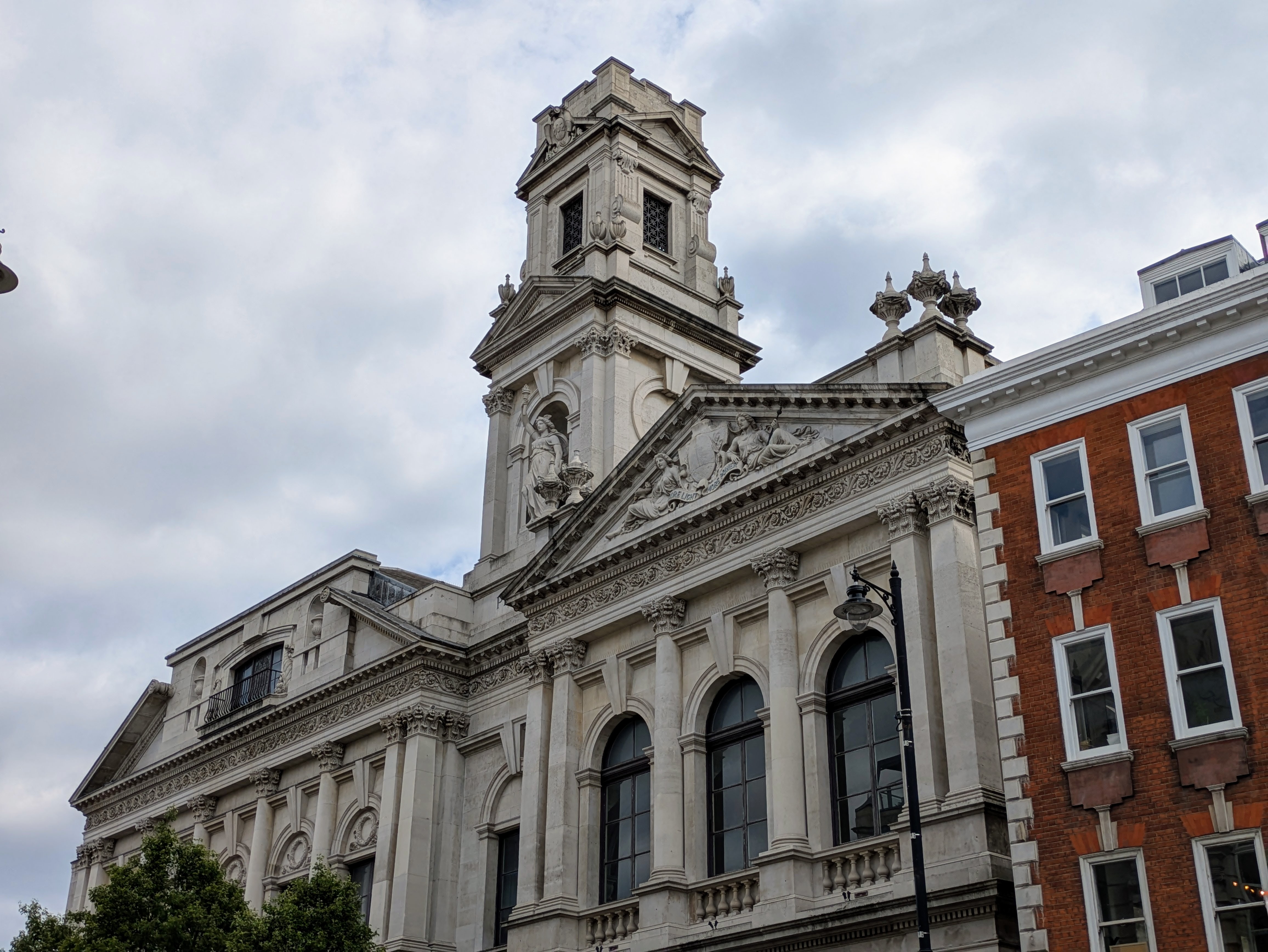
I wrapped up my Tuesday activities with an evening tour of Shoreditch Town Hall as part of the second annual Hackney History Festival (a whole array of talks, walks and tours over two weeks). Like many town halls across greater London, this one was made redundant when the 28 former metropolitan boroughs were amalgamated into the current 12 metropolitan boroughs (of a grand total of 32 boroughs in greater London) of today. Several town halls have found new lives as arts, events and culture spaces. This tour was totally fantastic! We saw all the major rooms as well as various nooks and crannies of the basement (I think several people on the tour thought the basement was the best part). My favourite part of the building was the Assembly Hall, which has seen use for music hall performances, tea dances, discos, boxing, and will soon be a venue for South by Southwest when it comes to London this summer. You can read more of the fascinating history, see a timeline, and learn how the motto of Shoreditch council ("More light, more power") is incorporated into various aspects of the building. Kudos to Susannah Bramwell, Cultural Programme Manager, for giving us such a fascinating tour. 


More art, more Hackney was my theme for Wednesday. Good weather had returned! The art part began with a strenuous uphill walk to the Camden Art Centre, about 20 minutes from my gaff through lovely streets of NW3, where I saw an exhibition of Richard Wright, with works from 30 years of his career. This Turner Prize winner is another British artist who is new to me. The pieces are abstract, primarily geometric, meticulously painted and rather eye-hurty. One of the young women (probably an art student) who was invigilating told me that she could only look at the paintings for a limited amount of time before they made her head spin. 


After eating my packed lunch in the Centre's garden, I hopped on the overground (now the Mildmay and Windrush lines) to get to Shoreditch High Street. From there, I mooched around, looked at streetart and popped into several galleries -- Hales Gallery, Kate MacGarry Gallery, and the Autograph Gallery -- on my way up to Hoxton (another part of Hackney) for another building tour. 


Hoxton Hall was built at about the same time as nearby Shoreditch Town Hall, and also used as a music hall then and an events space now, but there the similarities end. It was purpose-built for a music hall promoter, who then sold it to another promoter, and saw a short life for this purpose. The small, galleried theatre was often filled to the rafters with people in all states of behaviour and inebriation, and it lost its license to operate as a music hall only 8 years after it opened. It was then purchased by the Blue Ribbon Army Gospel Temperance Movement, followed by a group of Quakers (it's still owned by Quakers today) and put to use for more uplifting purposes -- as a temperance hall, for the Girls Guild For Good Life, and in the later part of the 20th century for a variety of arts activities for children and youth. Like Shoreditch Town Hall, it is currently a Grade II listed performance space and will be a venue for South by Southwest next month. Both halls are registered charities and get no support from the government (or the Quakers). 


I was back on Southern Railway on Thursday, this time for a day trip to Lewes. Faithful readers of my blog will remember that I went to Lewes by car last year with friends, stopping first at Charleston, country home of Vanessa Bell and Duncan Grant, to see the garden there before touring the cottage and gardens of Virginia and Leonard Woolf at Monks House nearby. This time I was on my own, headed for Charleston in Lewes, a cultural space which is showing Vanessa Bell: A World of Form and Colour. The exhibition is very extensive, with works from her entire lifespan -- mostly paintings, but a few textiles, ceramics and covers she designed for her sister Virginia's books. I do enjoy her use of form and colour, but with over 100 works on display it got to have a bit of a samey quality to it. Many, many paintings of flowers. I was disappointed that none of the famous women dinner service she designed was included in the exhibition. It had gone on display in Milton Keynes soon after I flew home last autumn. But despite these complaints, as well as the dreadful lighting in the gallery, I enjoyed the exhibition and was glad I made time for it as I saw things I'll probably not have another chance to view. 


I spent the rest of the day wandering around the town, through the lovely Southover Grange Gardens (my packed lunch eaten on a bench there) and up and down the steep lanes of the old town, looking at the architecture, peering over walls into people's back gardens, and shopping at the indoor Lewes Flea Market. I bought a sterling and turquoise pendant necklace for 16 quid. The weather was perfect and I thoroughly enjoyed roaming around taking photos. 


Friday
was a day for more art -- some I thought was great and some not so much -- and a bit of World War II history. I met my friend Judy at the Barbican Gallery for the first show of the day, Noah Davis, a painter of huge talent who sadly died at the age of 32 from a rare form of cancer. Once again, I had to come to Britain to learn about a painter of African descent from my own country. His skill as a painter and his vision of bringing art to all communities were remarkable and this retrospective exhibition really struck a chord in London. I heard of people going to see it multiple times. If it ever comes to a city near you, buy a ticket immediately. In the meantime, click on the link above, see some of the paintings and watch the short trailer video. 


I hustled my tail from the Barbican to the London Archives, where I'd booked a free ticket for one of their document viewing sessions, this one on World War II in London. For these events, the curators bring out photos and various documents that are not normally on display and they give you an opportunity to walk around the tables to view/read them. I'd seen British Pathé newsreels about the volunteer firefighters who kept St Paul's from burning to the ground during the Blitz, but didn't know much else about the vast number of ordinary citizens who volunteered in London as part of the war effort. I learned about the ambulance drivers and ARP (Air Raid Precautions) volunteers, especially the women -- initially excluded from these roles -- who provided so much civilian support. 


I bought a proper sandwich from a deli, ate it in Myddleton Square Garden, and then faffed around in Islington for a bit. Next I got on the canal towpath and walked to the Victoria Miro Gallery in Wharf Road, where I saw Ian Hamilton Finlay: Fragments. It was about shapes, forms and lettering. I didn't really get it at all, possibly because I was tired or perhaps because it didn't make any sense to me.


Saturday was more of the Hackney History Festival. I heard two fabulous talks in the Round Chapel. In the morning, it was Nigel Smith's talk "Tales from Hackney's Memory Palaces", in which he recounted stories of some of the 60+ cinemas that once dotted Hackney. Nigel's website has more info about him, his walking tours and cinema history. With two hours to kill until the next talk I'd booked, I had a little walk with my friend Lesley, ate yet another pita and hummus sandwich on yet another park bench (Clapton Square Garden), and wandered the nearby streets on my own for a bit since this is an area I don't know at all. The afternoon talk was right up my alley -- "Look Up, Look Down: Spotting local history everywhere" from Amir Dotan, a Stoke Newington Historian. With much enthusiasm and wit, he encouraged us to look up and down all those things I love so much -- coal hole covers, boundary markers, plaques, rain hoppers, boot scrapers and street signs. Amir's website is a treasure trove of stuff about his projects, walks, events, etc. 


My week ended with two great guided walks on Sunday. In the morning, I did a walk I'd had on my list for years but had never worked into my itinerary -- the free Artists' Houses walk from Leighton House in Holland Park. Our guide John, who has lived locally his entire life, was so knowledgable about the architecture and artists who lived and worked in the Victorian studio-homes in the area. The walk covered only a small amount of territory but John filled it with a multitude of stories and much humour. 

I then got on the tube and made my way to Bloomsbury for the afternoon walk, gobbling a meal deal sandwich that I bought at Waitrose in the Brunswick Centre (alas, they were out of Forgotten Ends at the sushi counter) in Brunswick Square. This walk was about the life of Thomas Coram, founder in 1739 of the Foundling Hospital, an institution that provided shelter and care to children whose parents were unable to do so. Although I know a lot about the Foundling Hospital itself (after numerous visits to the Foundling Museum, listening to podcasts and reading about it), it seems I didn't know much about the man himself. Louise Choo, a qualified Camden walking tour guide who also guides in the Foundling Museum, took us around Bloomsbury and down through Clerkenwell to learn of significant places to Thomas Coram and his associates, including Coram's final resting place in St Andrew's Church Holborn.


That's my second dispatch, done and dusted. Please subscribe ("Follow"), leave a comment, and come back for more in a week or so to read about what I've been getting up to next. More warm and sunny days in the forecast!

Stats:

Monday:
£3.50 salad
£5.25 brownie
20,940 steps
8.59 miles

Tuesday:
£7 Velasco exhibition (half price with Art Pass)
£6.95 lunch
£13.48 groceries
£4 Shoreditch Town Hall tour
20,963 steps
8.69 miles

Wednesday:
£3 cookie
£8 bottle of wine
16,964 steps
6.96 miles

Thursday:
£14.79 train to Lewes
£6.25 Vanessa Bell exhibition (half price with Art Pass)
£1.50 pain au raisin for train journey to Lewes
£3.90 almond bakewell slice
£3.50 wine for return train journey
£16 pendant at flea market
16,644 steps
6.83 miles

Friday:
£9 Noah Davis exhibition (half price with Art Pass)
£4.50 sandwich
19,930 steps
8.19 miles

Saturday:
£11.40 farmers' market
£2.70 pastel de nata
£4 beer
£1.90 Daily Star
18,507 steps
7.84 miles

Sunday:
£2.60 sandwich
£10 Thomas Coram walk
£8.92 groceries
20,133 steps
8.26 miles