Monday, October 09, 2023

Third Week: Things slow down wee a bit

My adventures have been less frenetic this week, owing to several factors. Just before I arrived, I learned that there were to be tube strikes on 4 and 6 October as well as a rail strike on 4 October. I quickly changed my rail ticket to Eastbourne originally for 4 October to 19 October. And, after being caught in the tube strike last year when it took me nearly three hours to get home from Blackfriars, I cleared everything from my calendar for the 4th and 6th, figuring I'd stick to NW1 and NW3 on those days. In addition, many of the galleries were changing over exhibitions this past week so there was less to see. And finally, my sinuses/allergies have been acting up something fierce or, if it's worse than that, I've got a cold or a sinus infection. But it is NOT covid -- I've done two tests, 48 hours apart, both decidedly negative. My head has felt like a pumpkin the past few days, so I haven't taken on any far-flung adventures. I'm starting to feel a bit better, however, and I'll be off to uncharted areas in the coming two weeks.

In my last post I wrote about how I plan and organize my time. In this one, I thought I'd write a bit about food -- where I procure it, what I eat and how I prepare it. I've never been big on eating out in London as it's so bloody expensive. Food purchased at green grocers, supermarkets and farmers' markets is reasonably priced -- often cheaper than in the US and otherwise comparable, but rarely more expensive. Also, there seem to be more ready-made options in the supermarkets, e.g. soups, pasta meals, savory pies, etc. When I book an AirBnB, I always choose one with cooking facilities (often called "self catering" in the listing), at a minimum a fridge and microwave. My current gaff has the best kitchen yet -- small but fully equipped, with four gas burners, a small fridge, and a microwave/fan oven (though I haven't figured out how to use the fan oven yet). 

As you can see from my expense reports, I'm often spending 5-10 quid on groceries on any given day. Where I'm staying, I have a variety of options for food purchases. Tesco Metro is a five minute walk away, Nisa Local and a green grocer called Pomona are 8 minutes away, Budgens a few yards further on, and Waitrose a 20 minute walk in a different direction. Two great farmers' markets are within walking distance. Every Saturday, I walk 30 minutes up to Parliament Hill Fields to the farmers' market (and usually catch the C11 bus back home) and I sometimes hit the Wednesday market at Swiss Cottage, a 12 minute walk. There's an international/American market in Swiss Cottage, close to the Jubilee line if I'm going that way. There are certain items that I like to purchase at each of these locations. In particular, I've gotten really fond of the olive bread sticks, vegetable tarts and corn fritters that I buy at the Saturday market. And whenever I'm passing St John's Wood, I go to Panzer's Deli for a loaf of the fabulous rye, walnut and raisin bread. 

Breakfast is always fruit, yoghurt and/or kefir before I head out for the day. I often pack a lunch, which is always hummus in a pita with some carrot sticks. If I know that my day's adventures will find me near a Waitrose that has a sushi counter, I get my lunch there -- a Forgotten Ends cup of sushi bits that they cut off from the ends of the rolls and sell for only 2 quid. Or I might get a packaged sandwich from Tesco Metro or Sainsbury's Local. Occasionally, I'll buy lunch from a street food vendor. I then look for a nice green spot, usually a park, square or churchyard, where I can sit on a bench and eat my lunch. I usually treat myself to a cookie, pastel de nata or a piece of cake when I'm out and about for the day. Dinner is always back at my gaff where I make fairly simple meals. Last week I cooked up a veg curry soup and I've currently got a pot of minestrone going, made with odds and ends of veg that I had in the fridge. One of these days I'm going to get fish & chips from the chippy that's about a 10 minute walk away. 

Now for the recap of what I did this past week, starting with history:

  • Northern Ireland: Living with the Troubles at the Imperial War Museum (free) in Lambeth on Monday. As many of my mates know, I've been keen to learn as much as I can about this time in Irish history ever since (actually before) my trip to Belfast in 2015. This exhibition was the perfect balance of wall text, objects, photos, sound and video. The aim is to show a balanced view of events in the conflict, allowing voices from both sides to tell their version in their own words. My sympathies are republican/nationalist, so I reckon it was good for me to be open to hearing the experience of unionist/loyalists. 
  • While I was at the IWM, I tried to take in the exhibition Spies, Lies and Deception but it was an exercise in utter frustration. Too many exhibits, way too much wall text, no clear path through, and -- perhaps the worst of all -- tons of 9-10 year old school kiddies darting about randomly and generally being ill-behaved. I read a couple of interesting spy stories but didn't last long.  
  • That afternoon, I took the Waterloo and City line (a first for me!) to Bank, where I exchanged one last paper 20 pound note at the Bank of England (a maddening example of British bureaucracy and administrative excess) before going to the Guildhall Art Museum to see Treasures of Gold and Silver Wire. I debated putting this exhibition in the art section of this post (below), but really it was craft, rather than art, with a historical look at the output of the Worshipful Company of Gold and Silver Wyre Drawers on the occasion of their 400 anniversary. There were all sorts of military uniforms, ecclesiastical garb, royal regalia and theatrical costumes to see, all of which is decorated with silver or gold braiding and embroidery. When I've watched royal events on telly and seen the guards of the Household Division in their finery, I never realized that all that gold stuff that adorns their uniforms is actually made of precious metal that has been painstakingly coiled, crafted and applied. And then there was the gold costume that Helen Mirren wore when she played Cleopatra -- wow!
  • Tuesday found me at the British Museum, where I had scored a hot ticket (free, but you have to book ahead and do it fast) to see the Round Reading Room. It's a short tour (35-40 minutes) where your group is lead into the Reading Room to stand, gawp and hear the history of this amazing space and the names of some of the hundreds of famous scholars and authors who have used it. I thoroughly enjoyed it. I then proceeded to try to see a small number of the galleries filled with antiquities, mostly looted from other countries, but again was horrified at the crowds and the loud, sprawling, darting school children. I did look at some of the ancient Britain stuff, including the Sutton Hoo room, where the crowds were much thinner and I got a better look than at my last visit. 
  • On Wednesday, I went with a small group of people from the Primrose Hill Community Association's U3A (University of the Third Age) group to the People's Museum of Somers Town. A group of Somers Town locals had been exploring local history and doing occasional events for years before deciding about 18 months ago to open this storefront museum, housing photos, posters, printed materials and artifacts related to this working class area wedged between Euston and St Pancras stations. One of their current projects is to try to preserve/reclaim the ceramic finials and other decorations, designed by sculptor Gilbert Bayes, on the Sidney Estate (social housing). One of the directors gave us an informal one-hour talk about the area's history and the group's efforts. Our visit to the museum was interesting and enjoyable. 
I visited a number of historic houses in NW3, most of which had great art on display, either from their permanent collection or as a temporary exhibition:
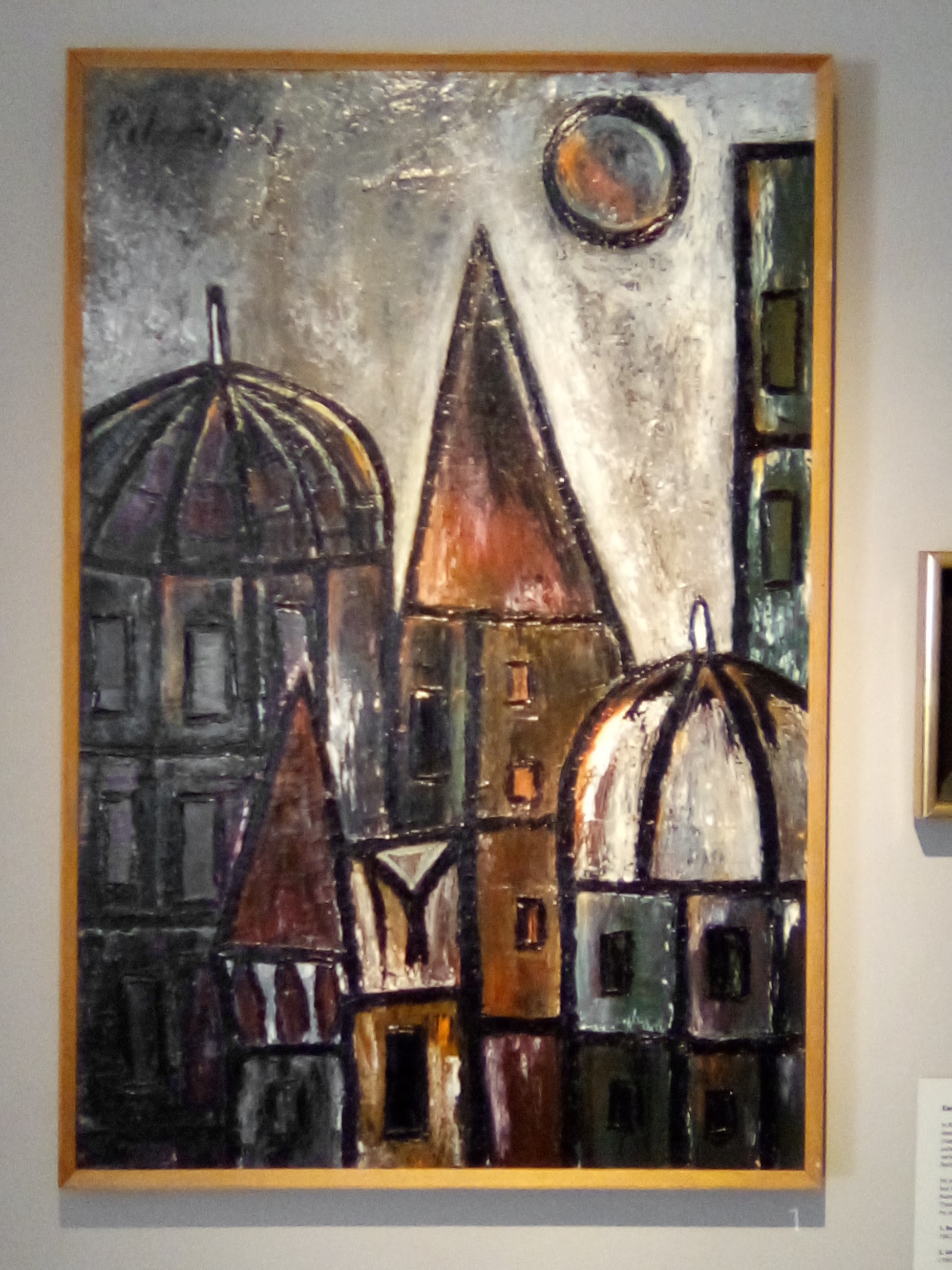
  • Friday was an absolutely gorgeous autumn day, so I decided to make the most of it by mooching around Hampstead and across the Heath. My first stop was Burgh House, which I'd visited before. The house itself, though old, is not a house museum per se, but a building owned by the local council and used for events, exhibitions, talks, music performances, etc. They keep it going on income from the busy cafe, ticketed events and from renting it out as a popular wedding venue. Art exhibitions, usually featuring artists with ties to the NW3 area, are free. I went to see Finding Joy in a Landscape, the paintings of Lancelot Ribiero, a man originally from Goa who settled in Belsize Park and had his studio just one street over from where I'm staying. His colourful paintings filled me with joy and made me eager to explore Hampstead Heath, despite my sore throat and running nose. 

  • The higher I got in altitude as I walked up the Heath, the clearer my sinuses felt. Maybe it was the sunshine and warm air, or maybe I was escaping the pollution of downhill London, just as people have been doing for hundreds of years since they first fled the city's filth to take in the clean water and atmosphere of Hampstead. My next stop was Kenwood House (another free venue) at the top of the Heath, which I reached up the western pathways with the aid of Google maps. Along the way, I occasionally passed other walkers, many with dogs, but often had the paths to myself. I thought I would be able to hear nothing but the rustle of leaves, birdsong and scampering squirrels, and there were brief moments when this was the case, but most of the time I could hear the sounds of civilization encroaching on the wildness -- jets roaring overhead and sirens wailing (probably ambulances headed to the Royal Free Hospital below in Pond Street). Kenwood has tons of old masters paintings hung on the walls all the time, but at the moment they've hung 17 paintings by Joshua Reynolds, some having undergone recent conservation, in an exhibition to mark 300 years since his birth. What a difference it makes to visit Kenwood on a weekday! My previous two visits had been on a Saturday and a Sunday, both on warm, sunny days when people were out in droves. While this day the outdoor patio of the cafe was full of people -- and many babies in pushchairs -- the rooms indoor were not at all crowded and there wasn't a school kid in sight. 
  • My final Friday destination was Keats House in the southern part of Hampstead (South End Green, near the Hampstead Heath overground station). Wanting to get there from Kenwood House by the quickest way possible, and not trusting my navigation skills in wild and wooded terrain, I pulled up CityMapper on my phone and asked it to give me the fastest route. Phone in hand, and keeping a steady eye on my blue dot as I moved down the Heath, the app took me along legitimate paths and desire lines, across open fields and through woods, getting me to Keats Grove without getting lost. Whew! This was my first visit to this small home where Keats lived prior to going to Italy where he subsequently died of TB. I don't know anything about Keats or about poetry in general, so the reverence people feel for him and this house were lost on me. And, about 15 seconds after entering one of the rooms, I had a terrible allergy attack and dashed out, with watering eyes and coughing like crazy. My entry was free with my ArtPass, so I didn't mind cutting my visit short. 
  • On Sunday, I trekked back up the hills of Hampstead to visit Fenton House and its garden, another first for me. It's a National Trust property, and there's an entry fee unless you are a NT member, but I had managed to score a limited, free pass to NT properties. The house was built in the 17th century, with the gardens laid out much later. Inside the house, though there isn't much furniture, there's a lot to look at -- art on every wall, Chinese and Japanese ceramics filling cabinets in many rooms, embroidery works and a collection of old musical instruments including spinets and harpsichords. In the early 21st century, an actor named Peter Barkworth, who lived locally, donated his art collection -- primarily post-impressionist works of the Camden Town Group -- to the house. I hadn't known about the CTG paintings at Fenton House prior to my visit; if I had, I surely would have come to see them sooner as CTG has long been a favourite of mine. Similar to the Ashcan School in American, the paintings depict everyday life in London and beyond. I really enjoyed both the style and the subject of the works. While the house is lovely, the real showpiece is the walled garden with its vast lawn, holly topiary trees, fruit trees, vegetable patch and flowering beds with autumn blooms. The weather couldn't have been better for this visit. 


During the week, I saw a couple of small art exhibitions at museums and galleries (all free), including:
  • Ed Ruscha: roads and insects prints at the British Museum. I wouldn't hang the ants and cockroaches on my wall, but I did admire these skillful prints, especially the swarming insects casting shadows across the paper.
  • Paula Rego: Letting Loose, paintings from the 1980s at Victoria Miro. Humans and beasts cavort around these large canvasses in what looked like fever dreams to me. It's my first exposure to her work and I can't say I liked these paintings, but I'll be on the lookout for more recent works from her to see how her style has evolved. 


And lastly, a few odds and ends of what I got up to this past week:
  • Rooftop garden at the Post Building in Holborn. Just a few minutes south of the British Museum, this new nine-storey building has a roof terrace that the public can visit for free. It offers great views of Bloomsbury to the north (you can pick out the individual squares with their tree canopies), including St George's Bloomsbury, the BM, Senate House, and further north to Hampstead in the distance, as well as south to the London Eye, the City, and Canary Wharf. In addition to the views, which I enjoyed far more than those from the much higher Sky Garden in the City, the terrace is serene and provides a lovely respite from the hustle of the streets below and the bedlam within the British Museum. 


  • Two "taster" walks as part of London Local Guiding Day. Six of the local guiding associations team up annually to provide free one-hour walks in different parts of town. I did the walks in Islington and King's Cross. 
  • The Primrose Hill Community Association walk was down to Regent's Park to look at the Frieze Sculpture 2023 outdoor exhibition this past week. Since I neglected to take photos on my phone the first time I saw the sculptures, this time I took some snaps for you all to see. 


  • I saw the play Anthropology at the Hampstead Theatre. Excellent acting and staging, engrossing plot about artificial intelligence and family dynamics.

The stats for week three:

Monday:
£2 tuna & sweet corn sandwich
£1.80 pastel de nata
£3.50 Guildhall Art Gallery (ArtPass concession price)
14,732 steps
6.05 miles

Tuesday:
£3.55 lunch
17,019 steps
6,96 miles

Wednesday:
£4.70 farmers' market
£12.60 groceries & wine
£2.85 sandwich
£6 bread from Panzer's
£1.50 cookie
22,688 steps
9.37 miles

Thursday:
£26 Hampstead Theatre ticket (OAP matinee price)
£1.75 throat lozenges
19,090 steps
9.37 miles

Friday:
£1.75 sandwich
£2.50 cookie
£6.93 groceries
£2.35 Boots
21,495 steps
8.78 miles

Saturday:
£11.10 farmers' market
£2.75 yoghurt
£4.05 more throat lozenges 
21,555 steps
8.93 miles

Sunday:
£2.45 pain au raisin
£.90 packet of Fisherman's Friend
16,879 steps
6.94 miles


Monday, October 02, 2023

Second Week: More art and many walks

Now that I've settled into my London routine, I thought I'd tell you a bit about that and how I organize my time. I've found I like to alternate days of time spent on my own rambling and taking photos with days involving activities with friends. If I spend too much time on my own, restorative as that is, I miss the company of my mates, though I do tend to chatter like a magpie when I eventually meet up with people after chunks of silent time. However, as an introvert by nature, I need the solitary time and there's nothing I like more than walking, getting lost and discovering new things and places along the way. 

As I'm doing my pre-trip research and planning throughout the year, I keep an ongoing spreadsheet listing the places and exhibitions I want to see, along with columns for any specific dates that something might be on, the postcode of the location, and notes about opening times and prices. I usually sort the spreadsheet by postcode. Once I've book a ticket for something -- an exhibition or a guided walk -- or planned a meetup, I look to the spreadsheet and Google maps to see if there are other places in the same or nearby postcode that I can work in before or after the planned event. For example, I had made plans to meet up on Tuesday afternoon with my friend Malcolm to see the Frieze Sculpture 2023 in Regent's Park. Since Bloomsbury is due east of there, I decided to take the tube to Euston station that morning and mooch my way westward, first visiting the Foundling Museum, then eating my packed lunch in Tavistock Square, and popping into the Petrie Museum for a quick look at some of the Egyptian artifacts before a fast walk to our meeting place Great Portland Street station, arriving only two minutes late (a miracle for me as I always underestimate walking times). 

Or, on a wide-open day like Wednesday, here's how I filled it up: I had errands to do in the morning (the weekly Swiss Cottage Farmers' Market, the magic money machine at NatWest in the Finchley Road, Waitrose for some other grocery purchases). I ate lunch back at the flat at noon, by which time the air had warmed up and, though overcast, it looked to be a pretty decent day. With nothing else on my itinerary, I decided I fancied a walk down to the canal and west on the towpath, something I hadn't done for many years. I ended up walking to Little Venice, on to Paddington Basin, catching the tube from Paddington to Maida Vale, and then zig-zagging my way on foot to St John's Wood. I had dropped several "Want to Go" pins around the area on Google maps (I've set these pins all across London), so I pulled up Google maps on my phone and had a butcher's at those nearby pinned items -- a giant bath plug and the rolling bridge at Paddington Basin, and in Maida Vale a double-height red phone box (public art) and a lovely tiled panel on a Victorian dairy. Before getting back on the tube to Swiss Cottage, I stopped into Panzer's Deli in St John's Wood (pinned as "Favourite" in Google maps) to buy a loaf of their fabulous rye, raisin and walnut bread. The rest of my week was a similar combination of planned activities and serendipity.  

Week Two found me doing more art exhibitions, some historical things, and several guided walks. First up, here's the arty stuff I saw (or didn't, as the case may be):

  • Paul McCartney Photographs 1963-64: Eyes of the Storm at the National Portrait Gallery. I'm not a huge fan of the Beatles (I'm much more "Let it Bleed" than "Let it Be") so I went to this exhibition somewhat reluctantly at the behest of my friend Molly. Expecting to see a bunch of amateur snaps, I was pleasantly surprised to find that, at the time these photos were taken, McCartney was working hard to develop a good eye and composition technique, learning a lot from his photographer brother Mike and from the many photographers who traveled with the Beatles during that year. After viewing the extensive exhibition, covering the group on tour in Britain, Paris, New York and Miami, I exited through the gift shop and bought Molly a book and postcard. I spent a little more time at the NPG, looking at the galleries of portraits from 2000 to present, including self-portraits of women, contemporary commissions and "Making a Modern Nation."


  • The Mother and the Weaver at the Foundling Museum. This exhibition, in one of my favourite museums (free with my Art Pass), featured 40 works of modern and contemporary art by women, all of which come from the collection of Ursula Hauser, a great collector of women's art. Many of the pieces are by Louise Bourgeois, whose work I love, and there were other pieces by artists who I recognized. 

  • Search History by Paul Stephenson and Niña by Sofia Enriquez, both at the StolenSpace Gallery in Shoreditch on Friday. I'd never been to this underground art gallery before -- it's small, but has done interesting shows. I'll be sure to return on future visits. 
  • Continuing up Brick Lane from the StolenSpace Gallery, I turned into Heneage Street to go to the newly-opened Gilbert and George Centre, only to find building work going on and the gallery closed for the week. Thoroughly gutted, I proceeded on up Brick Lane. 
  • Ghost Lines by Dan Kitchener (DANK) at the Brick Lane Gallery. I've been watching DANK paint on the streets of London for years and enjoyed seeing this exhibition of his signature street scene reflections. 
  • Not an exhibition per se, but I popped into Nelly Duff, a print gallery in Columbia Road to see what was on the walls. I really liked several prints -- by Shepard Fairey, Jo Peel and Eine in particular -- hanging there. 
  • Modernism at the Mall, a small exhibit at the Isokon Gallery about the artists who lived and worked in the nearby Mall Studios. Many of them, including Barbara Hepworth, shaped modernism in British art. The exhibition is mostly text boards, but they were showing a great companion video about a visit to the studio home of sculptor and printmaker Celia Scott who still lives and works there.
  • On Sunday I briefly visited the Conservatory at the Barbican Centre. The conservatory is generally open to the public at select times, the rest of the time (I think) being available to residents of the Barbican Estate and/or hired out for private functions. From October 1, there's a site-specific installation called Cloud songs on the horizon by Ranjani Shettar, featuring six large sculptures spread throughout the huge conservatory. Tickets are free but you have to book a time online and they are going like hotcakes. I'm happy to report that, for the first time ever, I made it into and out of the Bloody Barbican without getting lost. 


There was also the aforementioned Frieze Sculpture 2023, but all the photos I took were on my proper camera. Since Regent's Park is near to my gaff, I'll pop down again and take some photos on my burner phone so I can drop them into a future blog post. 

I also took in some history this past week:
  • Unforgotten Lives at the London Metropolitan Archives -- an exhibition of stories of Londoners of African, Caribbean, Asian and Indigenous heritage who lived and worked in the city between 1560 and 1860. There's an enormous amount of wall text to make it through, but I chose the stories I wanted to read and found those all very interesting and compelling. 
  • A brief stop at the Petrie Museum of Egyptian Archaeology at University College London. This small museum holds thousands of artifacts, only a fraction of which are on display, excavated in the early 1900s and donated to UCL. It was more than I could take in, but I did enjoy looking at the jewelry and was astounded to see three dresses that had been painstakingly conserved and reconstructed from fragments. 
  • On Friday, at the northern end of my walk from Aldgate and up Brick Lane to Columbia Road, I pushed on and visited the Museum of the Home (formerly the Geffrye Museum). Not much has changed since inside I was last there nearly 20 years ago (except for adding some more inclusive stories to the rooms), but since then they've opened a really lovely garden in the back. 
And finally, the THREE fantastic guided walks I went on:
  • Ghostsigns of Islington, led by my friend Jane Parker who does her guiding through Footprints of London. Anyone who looks at my photos on ipernity will know that ghostsigns have long been a keen interest of mine, so it was delightful to do this walk with Jane. I always learn so much about commerce, industry and everyday life in London through these signs, many of which are at least 100 years old. Often, a prime sign space is used over and over by different commercial endeavors -- as the years and the elements erode the layers of paint, it's like peeling back layers of time. Along the way, I saw parts of Islington that I knew and many spots that were new to me.

  • Lost Monasteries of Clerkenwell, led by another friend, Lesley Thompson, who leads walks through Islington Guided Walks and independently. Again, this was an opportunity for me to revisit some familiar sites, learning about aspects of Clerkenwell and its history that I hadn't known. Lesley skillfully led us around the remains of the medieval monasteries of St Bartholomew, St John, the Charterhouse, and the nunnery of St Mary, evoking a sense of what these places were like before and after the dissolution of the monasteries under Henry VIII. It amazes me that so much medieval stuff -- from fragments of walls to entire buildings -- has survived to this day and that these institutions still have an impact on London life. 
  • From Monoux and Morris to Beer and Bacon Jam, a walk around Walthamstow led by Joanna Moncrieff, also a Footprints of London guide, who I met for the first time on this tour. Again, this was a walk in an area I'd been before (but not since 2004!) and I got to see it with fresh eyes through the tour. Walthamstow has changed dramatically over the past nearly 20 years, but I recognized many places I'd seen before. Since gentrification, there's been a lot of new builds and refurbs. The stops along the route illustrated the rich history of the area. It was a fun tour -- and we saw not one but two almshouses! (I do love an almshouse as much as a ghostsign.) We started the walk at the William Morris Gallery and ended at God's Own Junkyard, a collection of neon signs many from former sex shops in Soho.


There's not much to say, let along complain about, regarding the weather. It chucked down rain a few times during my first week, but there was none during the second. It's primarily been overcast, with sunshine and blue skies occasionally. Temps have been in the mid-60s F every day. While rain has not been dropping out of the sky, the conkers have been! I started seeing them on the ground four or five days ago. I can't resist picking up the fresh, shiny ones and stuffing them into my pockets.


The stats:

Monday:
£11 Paul McCartney at the NPG (Art Pass price)
£2.30 pastel de nata
£ merch for Molly
15,738 steps
6.39 miles

Tuesday:
£3.50 slice of cake
£6 loaf of bread from Panzer's
18,213 steps
7.48 miles

Wednesday:
£10.30 groceries
£9.85 wine
£2 cookie
25,238 steps
10.32 miles

Thursday:
£10 Islington walk
£2.05 lunch (Forgotten Ends sushi from Waitrose)
£12.13 groceries
17,521 steps
7.22 miles

Friday:
£3 banana bread
19,800 steps
8.01 miles

Saturday:
£12.50 farmers' market
£11.07 groceries and wine
£15 Clerkenwell walk
£6 tea with Lesley
£20 to top up Oyster card (for out of zone 1-2 journeys)
18,088 steps
7.38 miles

Sunday:
£10 Walthamstow walk
£2.80 flapjack
16,877 steps
6.91 miles

Sunday, September 24, 2023

London 2023: The First Week


What a difference a year makes! Here I am back in Belsize Park. After a relatively uneventful flight, with minor weather delays en route and moderate turbulence across the Atlantic, my plane arrived at Heathrow a mere one minute late and, best of all, my luggage came on the flight with me. Thank you, Aer Lingus.

Now I'm well settled into the flat in Lambolle Road and am dusting the cobwebs off of the UK folder in my brain, reacquainting myself with the coinage (I still confuse the 10 cent US dime with the 5p UK coin), awakening the muscle memory for walking on uneven cobbles, revisiting all the grocery stores in the immediate area to get my favourite foods, refreshing my mental inventory of toilet locations, and learning the hard way that I need to add 10 minutes to any transit time estimates that I get on the Citymapper app, especially the walking bits. My legs are short and getting older, so I just have to reconcile myself to the fact that I can't walk at a London pace. To my #1 travel rule ("If you are nearby to an acceptable public loo, use it"), I've added a complimentary rule #2 ("If a bus comes along that's going in your direction, take it"). In both instances, you never know when the next one -- loo or bus -- will materialize.

Things in Belsize Park are essentially the same with a few minor changes. The Budgens grocery store has reopened since extensive renovations that began days after my 2022 arrival. It's a very nice store (check out the photos in the link above), though is now pricier than before. But I happily discovered that they still carry the Yeo rhubarb yoghurt that I love. In England's Lane, the French bakery still sells pastel de nata (priced at £1.90 each, which isn't much of a change if any) and there's a new convenience store that seems so-so. Best of all, right across from the tube station is a new charity shop that's fabulous. It supports the mental health charity Mind, which has shops in other parts of London but only just opened this one in the past six months or so. The shop is bright and cheerful, the staff and volunteers couldn't be nicer, and -- a lovely surprise -- the clothing is grouped first by type (shirts, skirts, dresses, etc) and then by SIZE, rather than colour like every other charity shop I've entered in the UK. 

A number of small and medium art exhibitions were ending during my first week so I darted about to catch a bunch of them:

  • Art and Artifice: Fakes from the Collection at the Courtauld. I'm a huge fan of the programme Fake or Fortune, in which Fiona Bruce and Philip Mould are always bringing works to the Courtauld Institute for analysis, so this was right up my alley. I kept expecting Fiona and Philip to pop their heads around a corner to offer more info, but no such luck. 
  • Black Venus at Somerset House -- Black women artists confronting and reclaiming images and representation in art since the infamous Hottentot Venus. 
  • Brian Clarke at Newport Street Gallery. Big, colourful, splashy, sometimes dark stained glass windows and screens:


  • Evelyn Hofer at the Photographers' Gallery. I absolutely loved this retrospective exhibition of a relatively unknown woman photographer (I'd not heard of her, though much of her work was done in America). I particularly liked the symmetry within her photographs.  


There's some new temporary public art around the Strand. This is an installation that's part of the London Design Festival, called Spirit of Place by Simone Brewster. There are five pieces, all made of cork.


And there's also a new installation on the low rooftop of Temple Station, called Slackwater by Holly Hendry. It references the movements of the nearby Thames.


On Thursday, I went on one of the weekly walks with the Primrose Hill Community Association. Loyal readers will remember how much I enjoyed participating in PHCA activities last year. This walk included stops at the blue plaques of three local residents who are less known than the usual blue plaque set: Agnes Arber (a botanist), Henry Wood (musician and conductor of the Proms) and Bhimrao Ramji Ambedkar, an Indian economist, social reformer and political leader. It was lovely to reconnect with the group and to learn about these three fascinating, accomplished individuals. 

Thursday evening, I saw the first of several theatre performances I've booked. This one was of "Indecent" by Paula Vogel at JW3, a Jewish community cultural centre about a 25 minute walk up the Finchley Road from my gaff. I thoroughly enjoyed the performance -- the staging, the acting, the music and the story. It's a play within a play within a play (a bit confusing at times), about the controversial performances in eastern Europe, New York City, ultimately the Lodz ghetto of a play by Sholem Asch called "God of Vengeance." I managed to miss the number 13/113 bus up and back down the Finchley Road by a minute or two. I watched them both pull away from across the busy road, which I didn't dare dart across. Hence the new rule about adding minutes to Citymapper's estimates. 

I did a house tour at the Cosmic House in Holland Park on Friday. I'd been wanting to see the inside of the building ever since it opened for public tours in 2021. This was the brainchild and home of post-Modern architect Charles Jencks and his family until his death in 2019. In 2018 it was given Grade I listing. My friend Simon, himself an architect, told me about the ticketing process. As soon as July, August and September tix became available, I was persistently on the website until I scored myself a ticket. By that evening, they were gone. Admittedly, I had neglected to do much reading about the house before my visit. I was delightfully surprised to find how whimsical the place is, with various humorous motifs (faces, action figures) throughout. If you want to book for future open days, you'll need to get on the mailing list and be ready to pounce when you are notified that it's time to book. 


I rounded out the week with a shopping trip to the Parliament Hill Farmers' Market on Saturday and a guided walk around the old Eton Estate part of Belsize Park on Sunday. Oh, and I got a covid jab on Sunday morning. I was hoping for the new formulation, but it will not be available in the UK for another two months. Meanwhile, there's a big push on to get the over-65s vaccinated with the old bivalent jab, which they told me has been just as effective as the new one in the clinical trials. Since I couldn't get the new formulation before I left the US, and I've been horrified by the lack of covid precautions here in the UK (nary a mask in sight), I decided I may as well get boosted with the bivalent formulation. I was able to get it at UCL Hospital in the Euston Road, without question about immigration status and without a NHS number. 

Here are the stats:

Tuesday (arrival day):
£10 to top up my Oyster card
£20 mobile phone package for 30 days
£1.90 pastel de nata
£22.98 groceries and wine
12,694 steps
5.14 miles

Wednesday
£156.30 one-month travel card
£6.50 shirt from charity shop
17,026 steps
6.92 miles

Thursday
£2.30 sandwich
£7.33 groceries
£15 ticket for Indecent at JW3
27,844 steps
11.35 miles

Friday
£5 Cosmic House tour
£1 veggie samosa in Portobello Road Market
£1.85 pastel de nata from Lisboa in Golborne Road
£8.50 wine
18,008 steps
7.41 miles

Saturday
£11 bread & veg from farmers' market
£4 Photographers' Gallery (Art Pass price)
18,702 steps
7.62 miles

Sunday
£2.27 groceries
13,299 steps
5.45 miles

Saturday, November 26, 2022

Recap and Reflections


After nearly 21 hours of travel from the time I exited the flat in Belsize Park, I opened my own door in Massachusetts, thus cementing the firmest resolution to emerge from this trip: I will never take a connecting flight to LHR again (unless Aer Lingus resumes its Hartford>Dublin>London route, which has worked so well for me in the past). And I will never book on Expedia again. While they did offer me the best fare I could find, I figured out that the cheap fare I got resulted in the carriers putting me in the last group to board and/or the worst seat. Lesson learned. 

When I set about back in February to plan this trip, I had two very clear aims in mind: to soak up as much history and culture as possible, making up for not being able to travel in 2020 and 2021, and to experience London as a Londoner, albeit a temporary one. The means of accomplishing this was by doing tons of research, scouring event listings and subscribing to various listservs whose target audience is residents rather than tourists. Secondarily, I hoped to meet new people and have genuine conversations, though I wasn't exactly sure how I'd go about that. But I knew that I didn't want to be perceived as a daft American whenever I opened my mouth. I found that the Londoners I encountered were open to chatting with visitors who are knowledgeable, engaged and who ask intelligent questions about their city and their lives. My curiosity about All Things London knows no bounds. As a result, I had many pleasant conversations with strangers on buses, in shops, at exhibitions, and on walks, all of which made my visit much richer. 

I've put together some other observations, travel tips and general reflections to share with you all.


  • Location: I stayed in Lambolle Road NW3, which is in Belsize Park, a brilliant place to be. I was near to the Hampstead Theatre, several small museums and art galleries in Hampstead, and the wonderful greenery and open space of Primrose Hill, Regent's Park and Hampstead Heath. One of the best things I did was to get on the email list for the Primrose Hill Community Association and learn of their weekly walks and other programmes. I thoroughly enjoyed having the opportunity to socialize and chat with people who live locally while walking across Primrose Hill or down to Regent's Park and back. The people I met were warm and welcoming, and I felt less like an alien each time I saw them. I regret that I didn't make time to participate in any of the other PHCA activities, such as their weekly lectures, movies, or the bar. I will do next time I visit. 
  • Food: The fridge in my flat was very small, so I did grocery shopping frequently. The price of food has definitely increased since I was last in the UK (my previous visit was pre-Brexit), but it is still much cheaper to eat in London than at home in Massachusetts. As I almost never eat meals in restaurants, I'm basing this observation on what I paid in supermarkets, greengrocers' shops and farmer's markets. That said, sticker shock greeted me when I bought my first packets of HobNobs and Ginger Nuts. I used to pay 99p per packet for them; they now cost £1.35. But produce and staples on the whole were very reasonably priced. A 500gr package of whole wheat penne (Tesco brand) costs 99p. I pay $2.79 for a similarly-sized box at my local co-op. Tesco or Waitrose brand pasta sauce was around £1 for a 500gr jar; a 16oz jar of Field Day sauce is $3-4 at the co-op. When I went to the Saturday farmer's market at Parliament Hill, I could buy non-organic carrots (6-7 to a bag), two red peppers, a large head of broccoli or cauliflower, or a bunch of scallions for £1 each. All the supermarkets stock fresh baked goods (rolls, baguettes, croissants, pain au raisin) daily for very cheap prices, e.g. 45-65p for a whole wheat roll or mini baguette. Bread from the local bakers, either at the farmer's market or in a bakery, was comparably priced to home but the selection was much greater. I couldn't get enough of the walnut raisin bread and olive bread sticks, neither of which I can get at home. And I could bang on about my love of pastel de nata (Portuguese custard tarts)! I must have eaten a dozen while I was in London, paying between £1.50 and £2.50 each. 
  • Transport: I had easy access to two tube lines -- the Northern Line at Belsize Park station, an eight minute walk from my AirBnB, or the Jubilee Line at Swiss Cottage, a 12 minute walk from my door. The nearest Overground station was about 20 minutes away at Hampstead Heath. Plus, numerous north-south and east-west bus routes crossed the area. It definitely paid off to purchase a one-month, zones 1-2 travel card. Only once did I inadvertently take the tube to a zone 3 station (Golders Green), using my cash balance, when I just as easily could have taken the bus (travel cards cover zones 1-6 on the bus). I did PAYG for the final 12 days, as I had three journeys beyond zone 2 that required loading money onto my Oyster card, and I think it worked out to cost about the same as it would have had I covered those days with a one-week travel card and five days PAYG. Note: You cannot load travel cards onto a Visitor Oyster card (purchased at Heathrow or ordered pre-travel from Visit Britain), but only onto a standard Oyster purchased at any station or from a newsagent. I've had my standard Oyster card for 16 years now.
  • Currency: The exchange rate was really good while I was in the UK, varying between $1.13 and $1.19 to the pound. I took £500 from a cash point (ATM) at Paddington Station on the day I arrived and I came home with a few notes in my pocket. For museum, theatre, walking tour and transport tickets, I used my credit card, generally booking online. Britain has fully embraced contactless payment. Many restaurants, cafes and cultural venues no longer take cash. This irked me no end. Even the toilets in the Royal Parks, which cost 20p to use, have replaced the coin slots in their turnstiles with contactless payment pads. I usually walk around with four or five pounds worth of coins in the pocket of my coat or slacks. One- and two-pound coins can pile up if you don't spend them, and they are heavy, so I like to use them for minor purchases like my Meal Deal sandwiches or a sweet treat from a caff. I keep my credit card deep in the recesses of my bag, inside a RFID blocking sleeve, so it's a PITA to dig around to pull it out, especially when I need to use the loo.
  • Culture: I made a real effort to seek out an array of cultural activities -- exhibitions, museums, walks, theatre, music -- that I could do on the cheap. My National Art Pass (~$82) was my key to exhibitions and museums, as it allowed me free entry to many venues and up to 50% off tickets to the pricier exhibitions. I ordered it a few days before I flew to London, and it arrived at my AirBnB (you need a UK mailing address to purchase) two days after I did. I thought that it would run for 12 months, but it actually doesn't expire until 31 Oct 2023! I'll be going back to London next autumn and putting it to further use. Most of the big museums offer free entry for their permanent collections and many venues, such as local libraries and archives, put on a host of talks that are free. At venues not participating in the National Art Fund scheme, I took advantage of concession price (i.e. discount for old people) whenever available. Some theatres offer discounted matinee performances for seniors. The events listing from ianvisits is a great resource for finding free and low-cost offerings. I subscribe to both his weekly events guide and the weekly news roundup. All in, I spent roughly $350 on ticketed entry. 
  • Budget: I didn't set out a particular budget for the trip, rather just aimed to do it as affordably as possible while still cramming in a ton of activities. The total for my 42-day stay in London (after using the reward points I'd accumulated during the pandemic) was $4,100, including airfare, transport in the UK, lodging, food and culture. I'd say I did pretty well. 
My readers have two questions for me. One asked if I now have a British accent. No, I don't, though I think my "a" sounds a bit softer (it's taken a long time to lose my Midwest twang). A lot of British slang and terminology has crept into my vocabulary over the past decade, however. Several people, when asking where I was from, told me that they couldn't place my accent, so I reckon it's mongrel. 

Another reader asked what surprised me the most. I was certainly pleased that everywhere I went people were friendly to me, once I made an effort to overcome my shyness to ask a question or just chat. Young people and those close to my own age were particularly convivial. And I was pleasantly surprised to find that I was very comfortable going to events on my own. 

I asked myself what I'd do differently next year. It would be great to be able to take a workshop or course, perhaps at the Bishopsgate Institute or City Lit, if the timing worked out. I'll watch for listings of course offerings as I start my next planning cycle. While I was in London, I really missed my weekly volunteer activities at home, so I'll be on the lookout for volunteer opportunities next autumn and will ask people at the Primrose Hill Community Association if they could use a hand with any of their projects. 

Finally, as promised, here are some photos of the neighbourhood where I stayed.

Belsize Village, with little shops and cafes, on the way to Hampstead:


Eton Avenue, probably the loveliest street in Belsize Park:


Along my favourite route from the flat to Swiss Cottage station:


And so, to sum it all up, it was marvelous and memorable. Thanks so much to my friends, hosts and to the people of London for accepting me as one of their own.